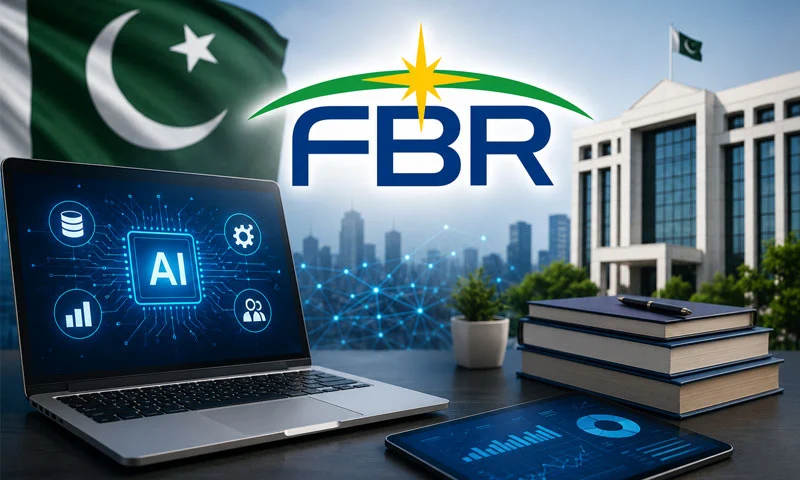
Finance Minister Muhammad Aurangzeb said on Saturday that the government was accelerating reforms to modernise the Federal Board of Revenue. The overhaul will use artificial intelligence, digital systems and integrated databases to strengthen Pakistan’s tax regime.
Aurangzeb spoke at the closing ceremony of the FBR’s Postgraduate Diploma Programme at Lahore University of Management Sciences. He urged tax officers to embrace AI and keep upgrading their skills. Modern tax administration now depends on technology, data sharing and stronger institutional capacity, he said.
Read More: FBR’s New Taftan Decision Could Unlock Billions in Pakistan-Iran Trade
“The government aims to create convenience for the public, restore the confidence of taxpayers, and establish a transparent system that can become the basis for Pakistan’s sustainable economic development,” Aurangzeb said.
Digital Systems and Cashless Economy
The government is introducing a new operating model for the FBR to improve institutional transparency and efficiency. It will link digital systems and databases across public institutions. Authorities can then identify evasion more effectively and make better policy decisions.
“The government is working with various national institutions to develop databases on modern lines so that information exchange can be made effective, tax evasion can be prevented and policy making can be done in a better way,” he said.
Aurangzeb added: “Modern digital systems and integrated data are the basis of effective tax administration.” He also told officers: “Today is the era of artificial intelligence (AI).”
The finance minister said the government had already uncovered major sales tax evasion cases. Those actions increased collections and benefited the national exchequer, he added.
Read More: Budget 2026-27: FBR Preparing New Tax Scheme for Shopkeepers and Small Traders
Prime Minister Shehbaz Sharif has placed special emphasis on FBR reforms and the shift toward a cashless economy, Aurangzeb said. The drive seeks to document economic activity, widen the tax net and improve financial transparency.
The reform campaign began with the sugar sector. The government later introduced monitoring and enforcement measures in the cement industry. Aurangzeb said no country could develop while widespread tax evasion continued.
LUMS Training Programme Marks Reform Milestone
Aurangzeb told the graduates that they now carry responsibility for helping transform the FBR. He urged them to build a modern, effective and people-friendly institution through professionalism and integrity.
“I am confident that these officers will play an important role in making the FBR a modern, effective and people-friendly institution,” he said.
Pakistan will mark 100 years of independence in 2047. Aurangzeb predicted that officials would remember the programme launched in 2026 as a milestone in the country’s institutional reform journey.
Read More: FBR Targets Social Media Income as New Tax Rules Emerge in Pakistan
FBR Chairman Muhammad Rashid Langrial said continuous professional training remained essential for modern and transparent tax administration. Such programmes equip officers with skills needed to improve institutional performance and strengthen Pakistan’s tax system, he added.
FBR and LUMS signed the programme agreement in September 2025. The first cohort included 51 probationary officers. Its curriculum covered data analytics, digitalisation, advanced accounting, e-commerce, trade analytics, supply chain management and international taxation.
Officials distributed awards and certificates among officers who performed exceptionally during the programme.