
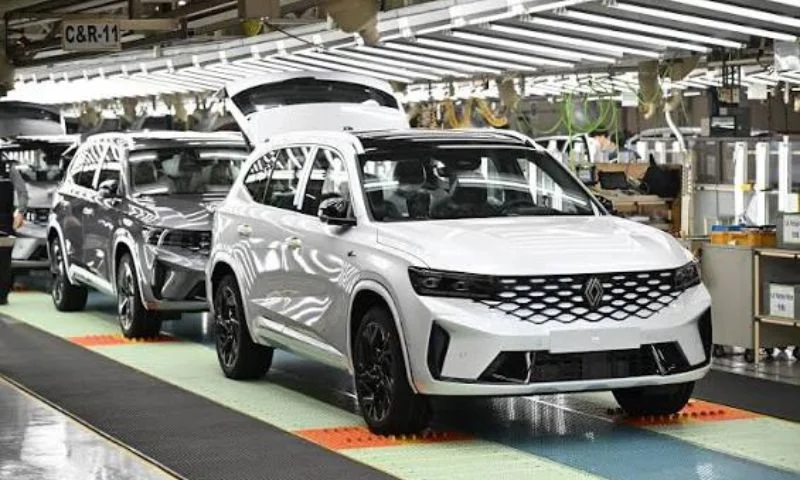
Morocco has strengthened its position as one of the world’s leading automotive manufacturing centers after producing 394,000 vehicles for Renault Group in 2025, making the North African country the French automaker’s second largest production hub worldwide after France.
According to a Renault Group report released on Monday, Morocco now manufactures nearly one in every six vehicles sold globally by Renault. The milestone highlights the country’s growing importance in the company’s international production network and reflects years of investment in manufacturing, logistics and supplier development.
Renault operates two production facilities in Morocco, one in Tangier and the other at Somaca in Casablanca. Together, the plants exported 82 percent of their total production to 63 international markets during 2025, including France, Spain, Italy, Germany and Türkiye.
Nearly 10,000 employees work across Renault’s Moroccan operations, while the Tangier factory alone employs 6,000 people, making it the largest automobile manufacturing plant in Africa.
Tanger Med drives global exports
A major factor behind Morocco’s success is the close integration between Renault’s factories and the Tanger Med Port, located only a few kilometres from the Tangier plant.
The port handled 161 million tonnes of cargo and more than 11.1 million containers in 2025, making it Africa’s largest port, the biggest in the Mediterranean and the 17th largest port globally. Its vehicle terminal covers 20 hectares and can process up to one million vehicles each year.
Renault ships around 8,000 finished vehicles every week through its dedicated quay at Tanger Med. The logistics network also includes 26,400 outbound trucks, 1,440 trains carrying 240 vehicles each, and 290 ships annually. Two railway lines connect directly to the Tangier factory, allowing vehicles to move straight from the assembly line to the port.
Rail transport also helps Renault reduce carbon emissions by approximately 90 percent compared with road transport.
Thomas Denis, Renault Group’s Supply Chain Director, said, “In a radius of a few kilometres, Morocco concentrates the Tangier plant, the supplier free trade zone and the Tanger Med port, creating a model of efficiency unique in the automotive industry.”
He added, “This exceptional proximity between production, suppliers, and logistics makes northern Morocco one of the most integrated automotive ecosystems in the world.”
AI, green energy and skilled workforce fuel expansion
Renault has also invested heavily in technology and sustainability. Three artificial intelligence powered control towers monitor inbound parts, outbound vehicle shipments and global risks such as strikes, extreme weather and geopolitical disruptions in real time.
The Tangier factory sources around 90 percent of its energy from biomass heating and wind power while using a closed loop water recycling system to reduce environmental impact.
Read More: Five New Chinese EVs in The Price of One Car in US: The Price Gap Shaking the Auto Industry
Renault has managed Morocco’s Institute for Training in Automotive Industry Professions (IFMIA) since 2011. The institute has delivered 3.2 million hours of training in robotics, automation and vehicle electrification while supporting suppliers and youth employment.
Morocco’s domestic vehicle market also continues to grow. Renault and Dacia together hold 38 percent of the country’s car market, making the company Morocco’s leading automaker. The country’s overall vehicle sales increased by 33 percent in 2025, driven by stronger consumer demand, wider financing options and new product launches.
Mohamed Bachiri, Director General of Renault Group Morocco, said, “Over the years, Morocco has become a key pillar of Renault Group’s global industrial footprint, built on industrial excellence, world class logistics, qualified talent, and a strong public private partnership.”
He added, “This long term collective commitment has enabled the emergence of a competitive automotive ecosystem with growing international reach, while supporting the kingdom’s industrial ambitions.”