
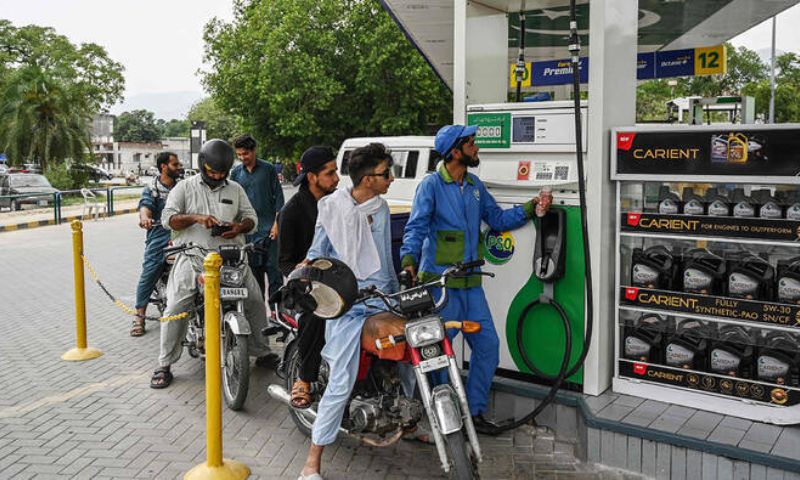
Pakistan has recorded the world’s second-highest increase in fuel prices since the start of the Iran war, with petrol and diesel prices surging 56 percent amid global energy market disruption and IMF-linked fiscal measures.
Data shared by Pakistan’s energy ministry showed the increase trails only Myanmar, where fuel prices rose by 90 percent during the same period.
The sharp rise has intensified pressure on households, transport operators and businesses already struggling with inflation and slowing economic growth.
According to official figures, petrol in Pakistan sold at Rs266.17 per liter before the disruption in the Strait of Hormuz. High-speed diesel stood at Rs280.86 per liter.
Read More: Petrol Crosses Rs414 as Pakistan Announces Massive Fuel Hike
Petrol now costs Rs414.78 per liter, while diesel has climbed to Rs414.58 per liter.
The government last Friday raised fuel prices by another Rs15 per liter, citing volatility in international oil markets after the outbreak of the United States-Israel conflict with Iran on February 28.
The war disrupted shipping routes and energy supplies through the Strait of Hormuz, a critical global oil transit route.
IMF Commitments Limited Government Options
Pakistan’s Energy Minister Ali Pervaiz Malik said the government had little flexibility because of commitments linked to the country’s $7 billion IMF programme.
“When this budget was made, there was no war at that time. Eighty rupees per liter [levy on petrol] was settled with the IMF that we would collect,” Malik told a Senate committee.
The minister explained that authorities initially kept zero petroleum levy on diesel because of its importance for agriculture and public transport.
“For this reason, 80 and 80, meaning 160 rupees had gone onto petrol, which, when the Prime Minister took up with the IMF, they gave an 80-rupee relaxation [on petrol levy] for one month,” he said.
Malik added that the temporary concession later expired after the government restored the original levy structure to secure IMF approval for a loan tranche exceeding $1 billion.
The minister said the government continued providing targeted support to vulnerable groups despite the price hikes.
“Even today, subsidies of several hundred billion rupees will still go to motorcyclists and those people, the weak classes, whom we can protect directly, through e-wallets,” he said.
Pakistan recently announced a Rs100 per liter fuel subsidy for motorcyclists, limited to 20 liters monthly.
The government also introduced monthly subsidies for transport vehicles and freight trucks to reduce pressure on transport costs.
Government Defends Oil Companies and Inventory Strategy
Malik defended the role of private oil marketing companies during the Senate briefing.
He argued that authorities needed to maintain enough liquidity in the market to ensure uninterrupted fuel imports during extreme volatility.
“This is how you end up with dead stock,” Malik said while explaining why the government avoided tighter controls on oil companies.
“The companies importing oil had to be ensured that they would not run dry. They needed to be provided with enough liquidity so they could continue purchasing the product.”
The minister warned that forcing companies to absorb losses could trigger shortages across the country.
Official data showed Pakistan increased fuel inventories despite regional instability.
Crude oil stocks rose to 515 kilotons by May 7 from 436 kilotons recorded on March 1.
Petrol inventories climbed to 662 kilotons, equivalent to nearly 30 days of cover, while diesel stocks reached 597 kilotons.
Malik also signaled that Pakistan could move toward broader deregulation of petroleum pricing after the crisis eases.