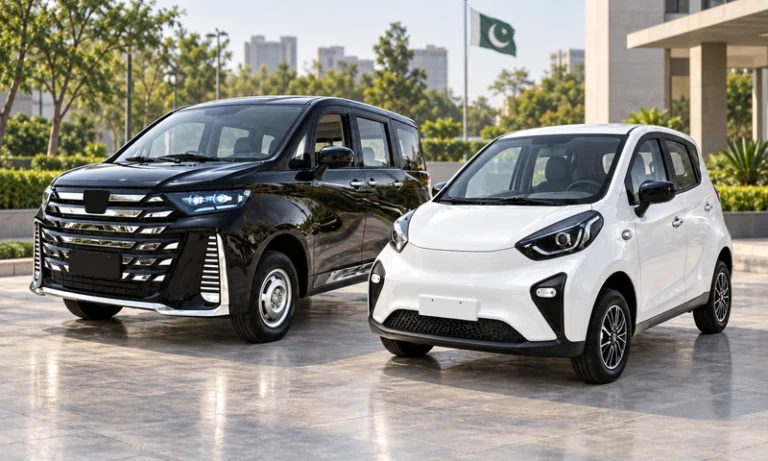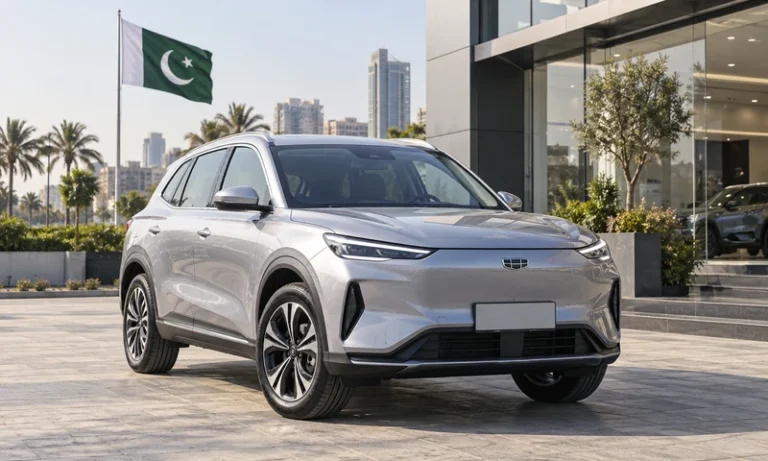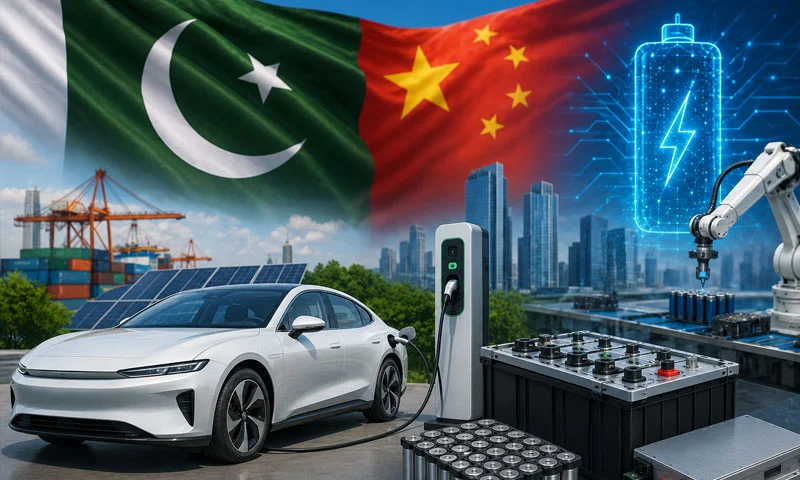
Haroon Akhtar Khan held separate meetings with leading Chinese and Pakistani companies to attract investment into Pakistan’s electric vehicle sector, according to the Ministry of Industries and Production.
The discussions focused on industrial collaboration, technology transfer and joint ventures. Officials also discussed plans to strengthen Pakistan’s manufacturing sector through modern EV technologies.
Khan said the government wanted to move beyond announcements and ensure practical implementation of agreements.
Read More: Suzuki Fronx Price Revealed: Offers Hybrid Power At A Surprising Price
“Prime Minister Shehbaz Sharif’s vision is to transform memorandums of understanding and agreements into practical implementation,” Khan said.
He added that authorities were working “day and night” to ensure effective follow-up and execution of investment plans.
Meanwhile, Chinese investors showed strong interest in Pakistan’s electric vehicle industry. Their focus included EV assembly, battery manufacturing and advanced energy storage systems.
Pakistan has recently increased efforts to attract foreign investment into industrial and technology sectors. The government aims to reduce import dependence and create employment opportunities through local production.
Industry experts say Pakistan’s growing population and rising fuel costs have increased interest in electric mobility solutions.
EV battery policy in final stages
Khan said the government was finalising a dedicated EV Battery Policy to support investors and manufacturers.
The proposed policy aims to encourage local production of lithium-ion and sodium-ion batteries. These batteries are widely used in electric vehicles, renewable energy storage and consumer electronics.
Read More: Pakistan’s Electric Revolution Gains Momentum as Bold Shift Targets Fuel Import Reduction
Currently, Pakistan imports most EV components and battery technologies. As a result, production costs remain high and local industrial growth stays limited.
Officials believe domestic manufacturing can lower import dependence and strengthen Pakistan’s industrial base.
In addition, Khan assured stakeholders that the government would ensure proper follow-up on memorandums of understanding and joint ventures.
He also stressed Islamabad’s commitment to maintaining a business-friendly environment for international investors.
“Chinese investment in Pakistan would generate significant economic benefits, strengthen local manufacturing and create new employment opportunities,” he said.
Pakistan and China have expanded economic cooperation under the China-Pakistan Economic Corridor in recent years. The partnership already includes projects in infrastructure, energy and industry.
Focus shifts to advanced battery technology
Khan said practical steps were underway to promote advanced battery technologies and support Pakistan’s EV industry.
The government plans to introduce modern lithium-ion and sodium-ion battery systems for industrial and consumer use across the country.
Globally, demand for EV batteries has surged as governments push for cleaner transportation systems. China currently dominates global EV battery production and supply chains.
Read More: ‘Fuel Chhoro, Electric Chalao’: Revoo Announces Major Discounts
Therefore, analysts believe Chinese investment could help Pakistan gain access to modern manufacturing expertise and advanced battery technology.
Experts also say the partnership could create training opportunities for Pakistani engineers and industrial workers.
Khan said industrial cooperation between Pakistan and China was entering “a new era of economic partnership,” driven by technology-focused investment and long-term collaboration.