

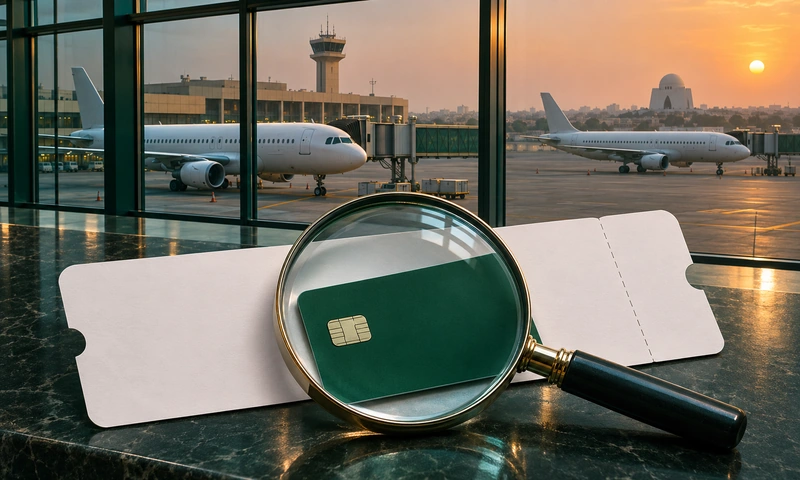
The Aircraft Owners and Operators Association (AOOA) has urged Pakistan’s government to conduct a five-year forensic tax audit of every airline operating in the country. The association estimates an annual gap of $2 billion to $2.4 billion in airline ticket revenue. It wants regulators to determine whether airlines processed ticket payments overseas and met their tax obligations in Pakistan.
AOOA founder Imran Aslam Khan called for immediate intervention in a November 11 letter to the federal minister for finance and revenue. He raised concerns that offshore payment gateways could keep ticket proceeds outside Pakistan’s banking system and beyond the view of tax authorities. The association’s estimate reflects a gap in the figures it compiled. Its letter provides no transaction-level evidence to confirm how much money moved offshore or whether any airline evaded tax.
How the association calculated the $2.4bn gap
The AOOA put annual ticket revenue at $3.2 billion to $3.6 billion, based on historical sales estimates from industry sources. It attributed about $750 million to Pakistan International Airlines (PIA) and $65 million to other domestic carriers. The letter put officially recorded foreign remittances at $80 million to $411 million.
Using the upper remittance figure, the association accounted for $1.226 billion across those categories. That left a gap of roughly $2 billion to $2.4 billion in its calculation. The letter also cited market estimates of more than $6 billion for Pakistan’s broader flight market.
The AOOA estimated that roughly 40 to 42 scheduled airlines serve Pakistan, including four domestic carriers and around 36 or 37 foreign operators. It said foreign carriers account for nearly two-thirds of Pakistan’s international ticket revenue. The letter also questioned why some domestic airlines use foreign payment gateways.
AOOA calls for SBP payment controls and direct FBR collection
Khan wants all ticket sales for travel to or from Pakistan to go through gateways that the State Bank of Pakistan (SBP) regulates. He proposed collecting applicable taxes in real time through the Federal Board of Revenue (FBR) at the point of sale, “with zero exemptions permitted.” He also called for airlines to submit verified passenger manifests and sales records for every flight through an automated system.
Khan urged the government to hire three leading international audit firms to carry out separate forensic reviews. The audits would cover five years of passenger and sales taxes across all operating airlines. He called for immediate recovery of any shortfalls the auditors identify.
The SBP’s Foreign Exchange Manual already allows foreign airlines to remit surplus passenger and freight collections after accounting for local expenses and taxes. For passenger fares, banks can authorise remittance only after travellers complete their journeys. The rules also require supporting sales records, including statements from the International Air Transport Association’s Billing and Settlement Plan and detailed counter sales reports.