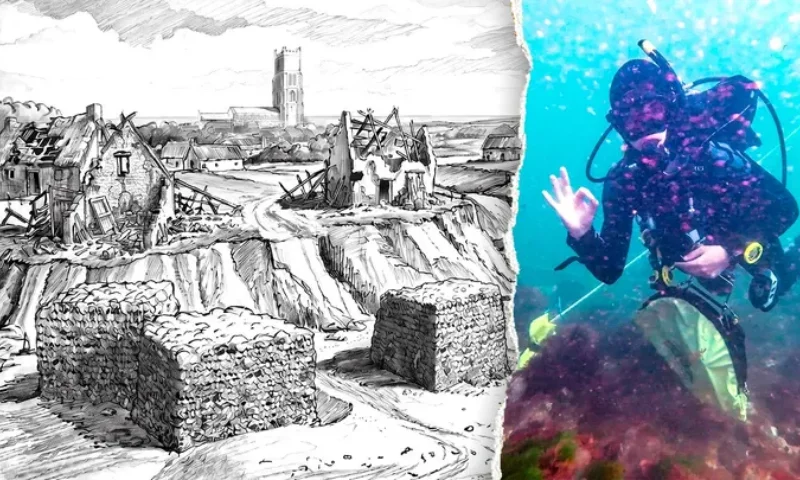
Volunteer divers have photographed 25 underwater features believed to belong to Shipden, a medieval English settlement lost to the North Sea around 700 years ago.
The survey off Cromer, Norfolk, recorded marine-covered stone structures rising from the sandy seabed. Researchers believe the photographs provide the first visual record of these particular remains.
However, the discoveries have also challenged a local legend about a submerged church tower.
Stone structures survive beneath the sea
Divers from the East Anglian branch of the British Sub-Aqua Club surveyed the site for the Alfred Savin Project.
Unusually calm summer conditions helped them photograph and map features despite the North Sea’s often difficult diving environment.
They documented flint-built structures, cut stone and lower sections of stone foundations known as caissons. Flint served as a common building material in medieval Norfolk.
Some remains still stand eight to 10 stone courses high.
Read More: China Launches World’s First Floating Artificial Island for Deep-Sea Research
Researchers are investigating whether the caissons formed part of medieval sea defences. Another possibility links them to a pier authorised in 1390.
Specialist photography has also helped produce preliminary three-dimensional models.
The project’s website places features roughly 400 metres or more offshore. It cautions that apparent walls could represent wharves or coastal defences rather than buildings.
Church Rock legend faces questions
Historical records confirm that Shipden lost a church to the sea. Divers have not identified remains that conclusively belong to it.
Local tradition associates Church Rock with the submerged tower of St. Peter’s Church. The latest observations suggest the formation could instead represent medieval coastal defences.
Lead diver Nick Schiller said the team originally sought further remains of the Victoria, which wrecked on Church Rock in 1888.
“However, it’s been a bonus to help the Cromer team to take some steps forward in understanding the town of Shipden and the port of Cromer,” said Schiller.
The wreck later underwent demolition because it threatened shipping, potentially disturbing earlier archaeological remains.
The church’s precise location remains unknown.
Medieval records offer further clues
Accounts cited in the reporting describe Shipden’s 1086 Domesday community as having 117 residents, three acres of meadow and two churches. They also describe a harbour and “woodland capable of supporting 36 pigs”.
The Time and Tide Museum’s historical account similarly describes a fishing community with 117 villagers. It records the loss of part of the churchyard in 1336, followed by the church by around 1400.
Coastal erosion gradually consumed the settlement, while Cromer became the dominant name in local records.
Read More: Pakistan Food Security at Risk From Climate Stress
Peter Stibbons, chairman of the Friends of Cromer Museum and project director, said researchers were comparing medieval documents with physical evidence.
“Those of us brought up in Cromer have always known the story of Church Rock, so it’s a big step to saying the legend may be incorrect,” Stibbons told Jam Press.
He added, “For the present, we’re putting forward ideas rather than conclusions.”