


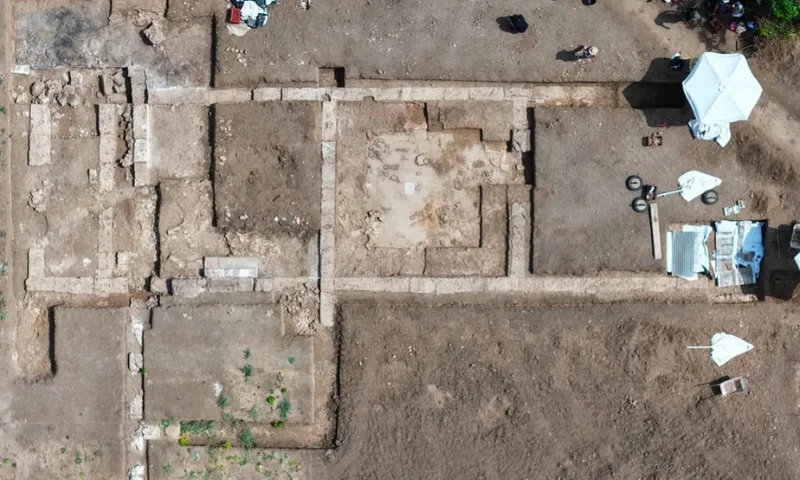
Archaeologists in northern Greece have uncovered ornate mosaic halls at a 2,400-year-old complex that may have housed Alexander the Great’s school. The discoveries strengthen the proposed connection between the royal gymnasium at ancient Mieza and his teacher, Aristotle.
The excavation offers fresh clues about elite Macedonian education, combining classroom lessons, athletic training and formal dining.
Mosaic halls reveal royal connections
Archaeologist Angeliki Kottaridi, director emerita of antiquities with Greece’s culture ministry, leads the project, which began in 2024.
The ministry places the complex near modern Naoussa. It covers approximately 30 stremmata, equivalent to three hectares or 7.4 acres.
Earlier excavations revealed a palaestra, or wrestling area, a stadium, arcades and a covered running track stretching roughly 200 metres. The sheltered track allowed training in poor weather.
Read More: Here Is How Your Research Could Build a $100 Million Company
Researchers have also identified lecture rooms with stone desks within the Didaskaleion, meaning “place of teaching.”
The latest discoveries include two banquet halls and a central vestibule covering more than 160 square metres. Both halls retain mosaic floors and raised platforms for reclining couches.
Each hall accommodated ten couches and at least 20 diners. Their decoration closely resembles Philip II’s palace at Aigai.
Kottaridi links these similarities to a complex built “for the education of his son Alexander and the children of the noble Macedonians.”
Writing tools and lessons in etiquette
The ancient biographer Plutarch described Aristotle teaching Alexander at Mieza. Greek gymnasia combined intellectual instruction with physical exercise.
The banquet halls suggest another educational purpose. Students likely practised the etiquette required for elite dining gatherings known as symposia.
Earlier finds include pottery, coins and four bronze writing styluses. Researchers suggest Aristotle’s pupils may have used them, although no evidence identifies Alexander as a particular tool’s owner.
Fragments of vessels for sacred Athenian olive oil also indicate access to a prized ancient commodity.
Together, the teaching rooms, sporting facilities and dining halls illuminate how Macedonian nobles prepared young men for leadership.
Scholars support identification, with caution
The discoveries do not conclusively establish that Alexander studied inside these particular buildings. Nevertheless, independent scholars consider the evidence persuasive.
“All the evidence suggests this is the school Philip provided for Aristotle to tutor the young Alexander and his fellow students.”
Jeanne Reames, director of ancient Mediterranean studies at the University of Nebraska at Omaha, offered that assessment.
She hopes further work will “shed more light on elite education in Macedonia in the second half of the fourth century B.C.E.”
Read More: China Launches World’s First Floating Artificial Island for Deep-Sea Research
South Dakota State University historian Graham Wrightson also welcomed the discoveries. They allow “us to put ourselves in the shoes of the young Alexander and understand more how he became the famous king.”
Neither scholar participated in the excavation.
Separately, the United States returned more than 300 antiquities to Italy in April 2026, including Alexander’s first-century C.E. marble head. It depicted him as Helios. New York authorities seized it from a gallery in 2018 following theft sometime between 1910 and 1960.

























