
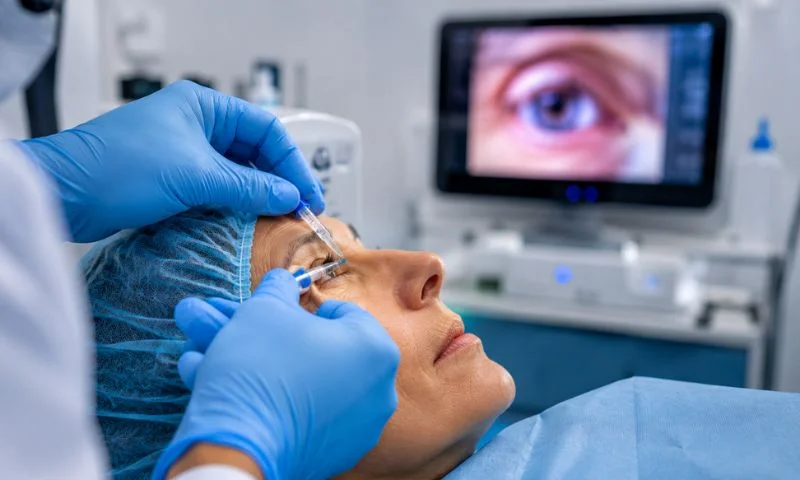
A biotechnology company in the United States has administered an experimental anti-ageing gene therapy to a human for the first time, marking a major milestone in the emerging field of cellular rejuvenation. Boston-based Life Biosciences announced that the first participant has received ER-100, an experimental treatment designed to partially reverse ageing at a cellular level. The therapy forms part of what researchers believe is the world’s first human clinical trial of partial cellular reprogramming.
The treatment targets glaucoma, a leading cause of blindness that damages the optic nerve and gradually reduces vision. Researchers also plan to study the therapy in patients suffering from non-arteritic anterior ischaemic optic neuropathy (NAION), a serious condition that can cause sudden vision loss.
Participants receive a single injection directly into the eye. They then take antibiotics over several weeks. The medication activates three therapeutic genes carried by the treatment.
Life Biosciences has launched the Phase 1 trial primarily to evaluate safety and tolerability. The company expects fewer than 20 patients to participate. Researchers are recruiting volunteers in Boston, New York, Los Angeles and Charleston.
The trial follows approval from the US Food and Drug Administration (FDA), which cleared the programme earlier this year.
Science Behind the Therapy
The technology builds on Nobel Prize-winning research by Japanese scientist Shinya Yamanaka.
Nearly two decades ago, Yamanaka demonstrated that a small group of genes could reset mature cells and return them to a stem cell-like state. Scientists later named these genes “Yamanaka factors.”
Researchers soon discovered that a complete cellular reset carried significant risks because cells could lose their identity or become cancerous.
Scientists therefore developed a safer approach known as partial cellular reprogramming. Instead of fully resetting cells, they activate selected genes for a limited period. The process aims to make cells behave like younger versions of themselves while preserving their original function.
Read More: From Bird Droppings to Bee Venom: Weird Skincare Trends That Actually Work
ER-100 uses three reprogramming genes to target damaged retinal cells. Researchers hope the treatment can rejuvenate ageing cells and restore lost vision.
Scientists selected the eye as the first testing ground because it offers a controlled environment. Changes remain largely confined to the treated area, reducing the risk of body-wide side effects.
Longevity Researchers and Investors Watch Closely
The trial has attracted attention from both the medical community and prominent technology figures.
Earlier this year, Elon Musk described human ageing as a “very solvable” problem during discussions at the World Economic Forum.
Life Biosciences co-founder and Harvard researcher David Sinclair later hinted that human trials were approaching.
When Musk posted the question, “ER-100?”, Sinclair replied with a single word: “Yes.”
Sinclair has previously reported that partial cellular reprogramming restored vision in laboratory mice after researchers damaged their optic nerves.
Despite the excitement, scientists remain cautious. Experts warn that altering gene expression could trigger unintended effects, including the possibility that some cells may become cancerous.
Researchers stress that ER-100 is not an anti-ageing cure. Instead, it represents the first real-world test of whether partial cellular reprogramming can safely rejuvenate human cells.
The trial’s results may take years to emerge. However, scientists view the study as a crucial first step in determining whether age-related decline can one day be treated at the cellular level.