
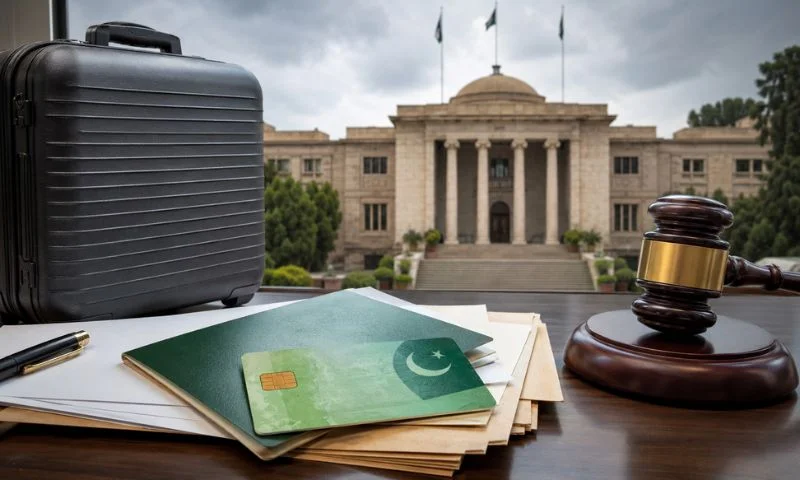
The Peshawar High Court has stopped authorities from deporting a man named Quaid-i-Azam after Nadra blocked his national identity card. The court also ordered him to appear before the authority’s verification board.
A two-member bench comprising Justice Waqar Ahmed and Justice Inamullah Khan heard the petition on Monday, July 27. Quaid-i-Azam had challenged the blocking of his Computerised National Identity Card, arguing that the action disrupted his personal and commercial affairs.
Advocate Saifullah Mohib Kakakhel represented the petitioner. Shahid Imran Gigiyani, an assistant director legal at the National Database and Registration Authority, appeared for Nadra.
After hearing both sides, the bench directed Quaid-i-Azam to present his case before Nadra’s verification board. It also barred the authorities from deporting him before his appearance before the board.
Petitioner Cites Business and Tax Record
Kakakhel told the court that his client conducts business in both Dubai and Pakistan. He maintained that Quaid-i-Azam is a Pakistani citizen who operates businesses and pays taxes to the government.
The lawyer said the blocked identity card had penalised his client and caused him “immense hardship.” A valid CNIC supports access to banking, travel documents, property transactions and many routine public and private services.
Read More: Senate Panel Approves Bill Allowing NADRA to Block CNICs
Kakakhel also questioned Nadra’s demand that the petitioner produce his uncle during the verification process. He informed the bench that other members of the petitioner’s family already possess Pakistani identity cards.
Gigiyani told the judges that Nadra had filed its formal response to the petition. However, he maintained that the authority considered Quaid-i-Azam’s identity card “suspicious” and had blocked it for that reason.
The reported order did not resolve the petitioner’s citizenship claim at this stage. Instead, the court sent the matter to Nadra’s verification mechanism while granting him temporary protection from deportation.
Legal Safeguards in Blocked CNIC Cases
The order follows a recent PHC approach in disputed nationality cases. In June, the court directed applicants claiming Pakistani citizenship to first approach Nadra and complete verification before seeking constitutional relief.
The PHC also told Nadra to refer complete cases to special verification boards. It ordered the authority to decide those cases within four months after receiving the applications and required documents.
Read More: Digital CNIC Now Legally Equal to Physical ID, NADRA Clarifies
Nadra’s official guidance states that a CNIC is issued to Pakistani citizens aged 18 or above. The card serves as a primary document for establishing a citizen’s identity.
Pakistani courts have also stressed that Nadra must follow due process when restricting identity documents. A Sindh High Court judgment held that the authority must issue notice and provide a fair hearing before impounding a card under Section 18 of the Nadra Ordinance.
That judgment described CNIC blocking as “an extreme act” because it can prevent a person from carrying out routine activities. In Quaid-i-Azam’s case, the PHC has placed verification first while protecting him from deportation before his board appearance.