A 123-year-old cooling system at Belfast’s Royal Victoria Hospital is offering cities a lesson as extreme heat raises health risks.
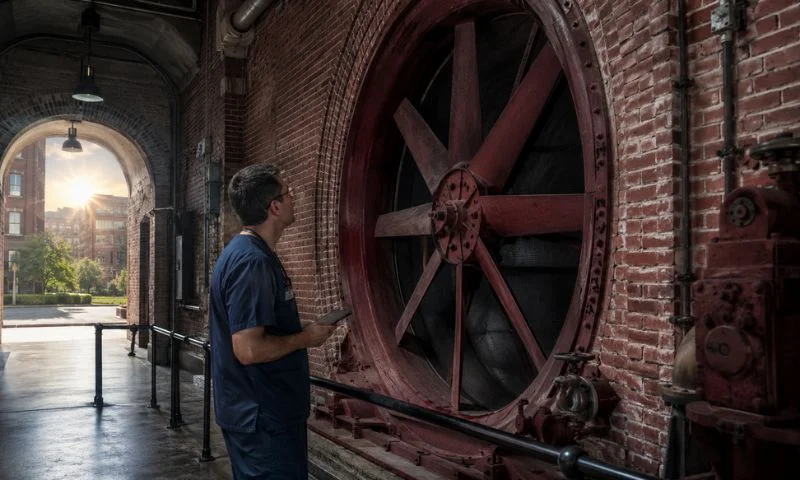
Installed in 1903, the brick-and-iron system helped make the hospital one of the world’s earliest mechanically air-conditioned public buildings. Two steam-powered fans pulled outside air across water-soaked coconut-fibre screens. The screens cooled, humidified and filtered soot before air entered a 150-metre corridor and hidden ward ducts.
Doctors recorded outdoor temperatures of 26C after the hospital opened, while wards remained near 18C. Alan Luney, the hospital’s senior estates officer, can still turn one enormous six-blade fan by hand. “After all these years, that you can spin that. I mean, there’s not a noise out of it,” he said.
Cooling as a Public-Health Tool
The original machinery no longer serves hospital wards, but its purpose remains urgent. David Eisenman of UCLA said, “Cooling is the number one most important approach to reduce the health risks of heat – and often what’s required is air conditioning, or active cooling.”
Research suggests air conditioning prevented about 195,000 deaths among people over 65 in 2019. In hospitals, cooling can reduce mortality by up to 40% during extreme heatwaves. Authorities therefore treat cooling failures as critical incidents.
The 2003 French heatwave showed the danger and caused about 14,800 excess deaths. Researchers later reviewed more than 340 heatstroke patients across 80 French intensive-care units. They found patients managed without air conditioning had a 76% increased risk of death.
Old Methods Inspire Modern Shelters
The Belfast system also resembles newer low-energy cooling projects. In Jodhpur, India, a public station uses solar-powered fans and water-misted khus grass panels. The cabin can lower indoor temperatures by as much as 12C when outdoor heat approaches 50C.
Spain is developing climate shelters with cooling, drinking water and seating. London has also mapped libraries, museums, churches and other locations that remain reliably cool.
Nigel Keery of Belfast Health and Social Care Trust said the 1903 design created “what we would call a hygienic environment.” It avoided opening windows to the coal dust and soot that polluted industrial Belfast.
Cooling Brings a Climate Cost
Air conditioning uses about 7% of global electricity and produces roughly 2.7% of fossil-fuel and industrial carbon dioxide emissions. Refrigerants add further warming risks. Meanwhile, the International Energy Agency says space cooling is the fastest-growing source of energy demand in buildings.
Passive measures such as shade, white roofs and insulation can reduce cooling needs. However, University of Leeds engineer Catherine Noakes warned, “We’ve gone past being able to do it all passively, particularly in cities.”
The challenge is to expand life-saving cooling without worsening the crisis driving extreme heat. Belfast’s system points toward efficient machines, cleaner power, public cooling spaces and heat-resistant building design.
Royal Victoria Hospital itself still lacks full air conditioning because, Keery said, it is “too expensive.” Engineers nevertheless preserved its pioneering system. “It was in a forgotten corner,” he said.