As heatwaves grow stronger, air conditioners are becoming essential in many cities. They protect people from dangerous heat and help homes, hospitals and offices remain functional.
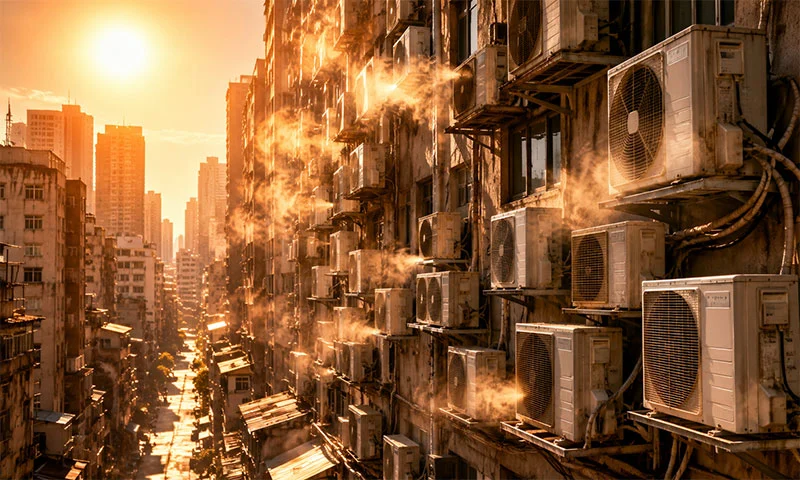
However, the rapid growth of air conditioning creates a serious urban problem. An AC cools the air inside a room but releases heat outdoors.
When thousands of units operate together, they can make streets and neighbourhoods even hotter. The effect becomes more serious in crowded cities with limited trees and poor ventilation.
Read More: UK Orders Air Conditioner Removal as Europe Swelters. But Why?
This cooling paradox is increasingly relevant for Karachi, Lahore, Islamabad, Rawalpindi, Faisalabad and Multan.
Where Does the Heat Go?
An air conditioner does not eliminate heat. It removes heat from a room and transfers it outside.
The outdoor unit releases both indoor heat and heat produced by the compressor. Therefore, the total heat released can exceed the heat removed from the room.
One household unit has a small impact. However, thousands of units operating together can change local temperatures.
Apartment buildings, offices, markets and shopping centres often run cooling systems at the same time. Their outdoor units continuously release hot air into streets and narrow spaces.
AC Waste Heat Can Warm Neighbourhoods
Research led by Arizona State University found that AC waste heat increased nighttime temperatures in some locations. The rise exceeded 1 degree Celsius in certain urban areas.
Lead researcher Francisco Salamanca warned that this could create a feedback loop. Hotter streets increase cooling demand. More cooling then releases additional heat outdoors.
A separate study of office districts in Tokyo reached similar conclusions. It estimated that AC waste heat could raise local temperatures by 1 to 2 degrees Celsius.
The impact may be stronger in dense business districts. Large buildings often use powerful cooling systems for several hours each day.
Why Nighttime Heat Is More Dangerous
The warming effect can become more noticeable after sunset.
During the day, hot air mixes through a larger part of the atmosphere. At night, the air near the ground becomes more stable.
As a result, heat from buildings and AC systems can remain trapped near streets. This prevents neighbourhoods from cooling properly.
Hot nights are especially dangerous because the human body needs cooler conditions to recover. Continuous heat can increase health risks for older people, children and outdoor workers.
ACs Are Not the Only Cause
Air conditioners are not the main cause of urban warming.
Concrete buildings, asphalt roads, traffic and shrinking green spaces remain major factors. Dense construction can also block natural airflow.
These conditions create the urban heat island effect. Built-up areas absorb heat during the day and release it slowly at night.
Research on Karachi has linked urban expansion and land-use changes with rising heat hotspots. Paved surfaces and concrete structures prevent many areas from cooling after sunset.
AC waste heat adds another layer to this existing problem.
Growing Electricity Demand
The environmental impact of air conditioning extends beyond outdoor heat.
The International Energy Agency says space cooling is the fastest-growing source of energy demand in buildings.
Cooling demand is expected to grow rapidly in developing countries. Population growth, urbanisation and rising temperatures will drive much of this increase.
Read More: Solar Boom Today, Waste Crisis Tomorrow? The Hidden Challenge of Solar Panels
Greater AC use also places pressure on electricity grids. During heatwaves, demand often reaches its highest level.
This can lead to power cuts, higher electricity costs and greater dependence on backup generators.
Impact on Climate Change
The climate impact depends partly on how electricity is produced.
When power comes from coal, oil or gas, greater AC use creates more greenhouse gas emissions. These emissions contribute to global warming.
Refrigerant gases can also damage the climate if they leak. Some refrigerants have a much stronger warming effect than carbon dioxide.
The UN Environment Programme has warned that global cooling demand could more than triple by 2050.
Under current trends, cooling-related emissions could also rise sharply. This would make global climate targets harder to achieve.
UNEP Executive Director Inger Andersen has said the world cannot simply air-condition its way out of the heat crisis.
Cooling Remains Essential
Experts do not suggest abandoning air conditioners.
Cooling can save lives during severe heatwaves. It is especially important for hospitals, schools and vulnerable households.
The practical goal is to reduce unnecessary use. Buildings should remain cooler before mechanical cooling becomes necessary.
A passive-first approach can reduce both indoor heat and electricity demand.
Reflective and Insulated Roofs
Roofs absorb a large amount of solar heat.
Dark roofs can become extremely hot during summer. They then transfer much of that heat into rooms below.
Light-coloured or reflective roof coatings can reduce heat absorption. Roof insulation can also slow the movement of heat indoors.
In suitable buildings, roof gardens may provide extra protection. However, the structure must support the additional weight.
Water availability and maintenance costs must also be considered.
Shade Windows From Outside
Windows allow direct sunlight to enter homes and offices.
External shades, awnings and covered balconies can block sunlight before it reaches the glass. This is usually more effective than indoor curtains.
Read More: Air Pollution May Be Damaging Your Kidneys Without Warning
Trees can also shade windows and walls. However, they should be planted carefully to protect buildings and underground services.
Reflective glass can help in some buildings. However, it may push heat towards nearby streets or structures.
Improve Natural Ventilation
Good ventilation can reduce indoor heat during cooler hours.
Windows on opposite sides of a room can create cross-ventilation. High openings can also allow rising hot air to escape.
People can open windows during cooler mornings and evenings. They should close them when the outdoor air becomes hotter.
Ventilation works best when buildings are designed around local wind patterns.
Dense and poorly planned construction often blocks these natural air paths.
Use Ceiling Fans With ACs
Ceiling fans use far less electricity than air conditioners.
Fans do not lower the actual room temperature. However, moving air helps the body feel cooler.
The US Department of Energy says fans can improve comfort at higher thermostat settings.
Households can set the AC between 24 and 26 degrees Celsius. They can then use a fan to spread cool air.
This approach reduces compressor use and lowers electricity consumption.
Setting an AC at 18 degrees does not cool the room faster. It only makes the system run for longer.
Choose Efficient Air Conditioners
Older and inefficient AC units consume more electricity.
Households should select properly sized inverter units with strong energy ratings. An oversized AC can cycle frequently and waste power.
An undersized unit may run continuously without cooling the room properly.
Filters should be cleaned regularly. Doors and windows should also be sealed to stop cool air from escaping.
Outdoor units need proper airflow. They should not be placed inside enclosed balconies or narrow spaces.
Can Air Coolers Replace ACs?
Evaporative air coolers consume less power than conventional air conditioners.
They can work well in dry climates. The process uses water evaporation to cool incoming air.
However, their performance drops in humid conditions.
This makes them less effective in Karachi and other coastal areas during humid months. They may work better in dry inland cities.
Users should also ensure proper ventilation because air coolers add moisture indoors.
Cities Need More Trees and Shade
Household action alone cannot solve urban heat.
City governments must reduce heat across roads, markets, footpaths and residential areas.
Protecting mature trees should be a priority. Large trees provide more shade than newly planted saplings.
Cities should also develop parks, shaded bus stops and covered pedestrian routes.
Tree selection must match local climate and water availability. Poorly selected species may fail during extreme heat.
Better Buildings Can Reduce AC Demand
Building rules should require climate-friendly designs.
New homes should include insulated roofs, shaded windows and better ventilation. Building orientation should also reduce direct sun exposure.
Construction rules can protect airflow between buildings. They can also prevent excessive glass use on sun-facing walls.
Government programmes could support low-income households with roof insulation and reflective coatings.
These measures often cost less than buying and operating a new air conditioner.
Cool Roofs and Reflective Roads
Cities can also use materials that absorb less heat.
Cool roofs reflect more sunlight than traditional dark roofs. Reflective pavements can reduce surface temperatures in some areas.
However, cities must study how reflected heat affects pedestrians and nearby buildings.
The best results usually come from combining reflective materials with trees and shade.
No single solution can cool an entire city.
District Cooling for Large Developments
Large housing projects and commercial districts can use centralised cooling systems.
District cooling produces chilled water at a central plant. The water is then supplied to several buildings.
Read More: Why Experts Are Looking Back to 1903 for Extreme Heat Solutions
These systems can be more efficient than thousands of separate AC units. They may also reduce the number of outdoor compressors.
However, district cooling requires strong planning, investment and regular maintenance.
It is most practical for new developments, hospitals, airports and commercial centres.
A Balanced Cooling Strategy
The solution is not to ban air conditioners.
Instead, cities must reduce dependence on them. Homes and buildings should first block heat through shade, insulation and ventilation.
Efficient ACs can then provide targeted cooling during dangerous conditions.
Cities must also expand green spaces and protect natural airflow. Building regulations should support heat-resistant designs.
Without these changes, urban areas may enter a damaging cycle.
Rising temperatures will increase AC use. Greater AC use will release more outdoor heat and raise electricity demand.
That will make streets hotter and force cooling systems to work even harder.
The future of urban cooling must therefore focus on both sides of the wall. Homes need to remain safe and comfortable. At the same time, outdoor spaces must remain liveable.