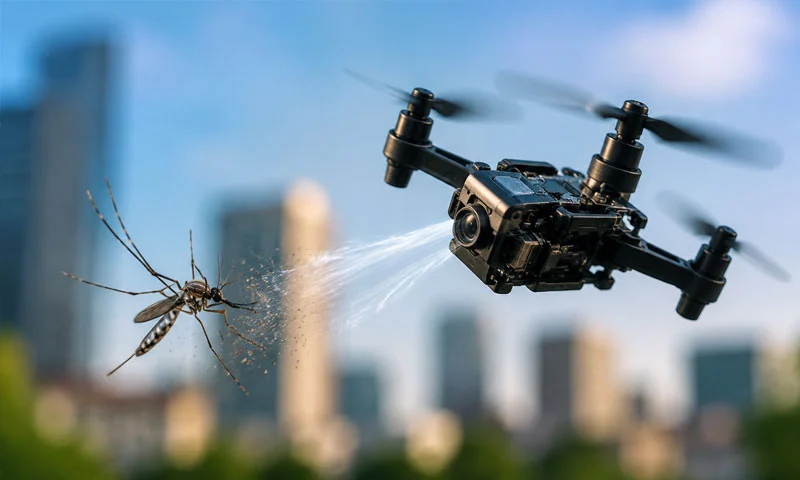
Engineers at Tornyol, a US startup backed by Y Combinator, are developing an AI-powered micro-drone designed to hunt mosquitoes in flight. The company says the technology could reduce mosquito-control costs by as much as 100 times.
The project aims to replace or supplement chemical spraying and other costly control methods. Instead, swarms of lightweight drones could patrol homes, gardens and wider urban spaces. They would identify mosquitoes and destroy them through direct mid-air interception.
Read More: Routine Dental Check Ends in Controversy After Patient Loses 12 Teeth
Tornyol was founded by engineers Alex Toussaint and Clovis Piedallu. According to Y Combinator, the startup uses low-cost components, including smartphone microphones and sensors commonly found in vehicle parking systems. Its custom software then turns small toy-style drones into autonomous mosquito hunters.
Drone Records First Mid-Air Insect Kill
On July 14, Toussaint posted a video showing what he called the company’s “first air-to-air kill”.
The footage showed a small drone chasing and eventually bringing down a moth inside a controlled testing area. The drone did not fire a projectile. Instead, it intercepted the insect and struck it with its spinning propellers.
Extremely excited to announce our first air-to-air kill of a flying moth by an autonomous micro-drone. This is a big step towards completely eradicating mosquitoes. pic.twitter.com/UhtNqwXCQI
— Alex Toussaint (@alextoussss) July 14, 2026
The test did not involve a mosquito, while the flight area remained limited. However, Tornyol considers it an important step toward building a system that can detect, follow and eliminate much smaller insects in real time.
Reports on the demonstration said the 40-gram, palm-sized drone tracked the moth without direct human control. The company still needs to prove that the system can reliably detect real mosquitoes in larger and less predictable environments.
The current prototype also faces practical limits. Reports suggest its battery supports only a few minutes of flight before the drone must return to its charging station. Therefore, a larger deployment would likely require several drones operating on coordinated schedules.
How the Mosquito-Tracking System Works
Tornyol’s stated goal is to develop drones weighing about 40 grams. They would rely on smartphone-grade microphones, ultrasonic sensors and custom signal-processing software.
Read More: Same Elephant Kills Four Family Members Over 14 Years
The system sends ultrasonic pulses and listens for returning echoes through a microphone array. Mosquito wings produce a distinct acoustic and Doppler signature. In theory, the software could use that signal to distinguish mosquitoes from moths, bees and other insects.
Scientific research has already shown that smartphone microphones and machine-learning models can identify mosquito species through wingbeat sounds. However, real-world accuracy can fall because of wind, background noise and overlapping signals.
Urban Mosquito Control Without Chemicals
Toussaint and Piedallu hope to deploy swarms across urban areas. The company estimates that around 10 drones could clear mosquitoes from one square kilometre, although that claim has not yet been demonstrated independently.
Read More: Couple Climbs Empire State Tower for Love and Lands in Custody
The potential public health impact remains significant. The World Health Organization estimated 282 million malaria cases and 610,000 deaths worldwide in 2024. Mosquitoes also transmit dengue, Zika, chikungunya and West Nile virus.
For now, Tornyol’s drone remains experimental. The moth test shows that autonomous interception is possible, but large-scale mosquito eradication will require longer battery life, accurate species identification and extensive outdoor trials.