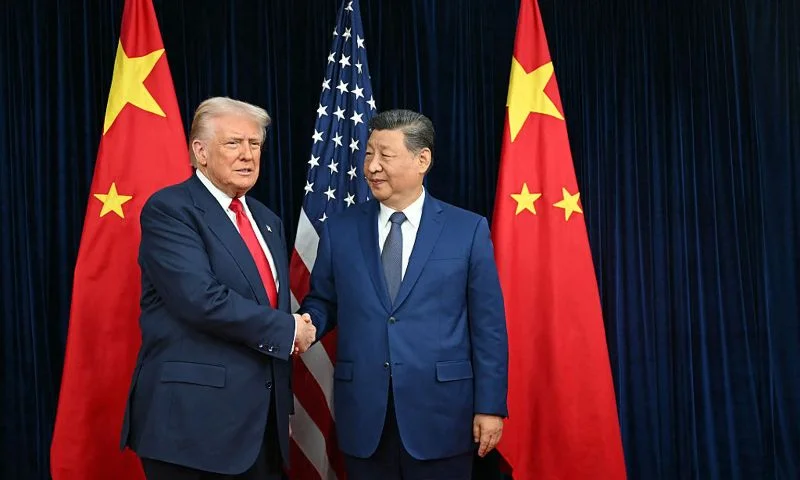
US President Donald Trump will travel to China this week alongside some of America’s most powerful business leaders.
Executives expected to join the delegation include Elon Musk, Tim Cook and Larry Fink.
A White House official familiar with the plans told the BBC that 17 US executives will accompany Trump during the Beijing visit.
The trip marks Trump’s first official visit to China in nearly a decade.
The visit comes at a sensitive moment for relations between the world’s two largest economies.
Trump is expected to meet Chinese President Xi Jinping as both countries continue navigating tensions linked to trade, semiconductors and artificial intelligence.
Tech and Finance Leaders Join Delegation
The delegation includes leaders from technology, banking, manufacturing and consumer industries.
Executives expected to travel include Kelly Ortberg, Ryan McInerney, Stephen Schwarzman, Jane Fraser and David Solomon.
Representatives from Meta, Mastercard, GE Aerospace and Cargill will also participate.
The absence of Jensen Huang has drawn attention.
Nvidia remains central to the US-China competition over AI chips and semiconductor technology.
Last week, Huang told CNBC that it would be a “privilege” to represent the United States in China if invited.
Another notable participant is Sanjay Mehrotra.
China restricted the use of some Micron chips in critical infrastructure projects in 2023 over national security concerns.
Micron later said the restrictions negatively affected its China business.
Semiconductors remain one of the most sensitive issues in US-China relations. Washington continues tightening export controls on advanced chips and AI technologies.
Trade and Iran War Add Pressure to Talks
Trump and Xi last met in South Korea during late 2025.
Both countries paused tariffs after that meeting following a prolonged trade confrontation that pushed duties above 100 percent.
The upcoming discussions are expected to focus on trade access, supply chains and AI competition.
The ongoing US-Israel war with Iran will also shape the talks.
Trump reportedly wants China to help facilitate a broader diplomatic arrangement involving Tehran and Washington.
China also wants the conflict to end because it relies heavily on Iranian oil imports.
Beijing has worked to manage disruptions in energy markets and global supply chains since the conflict began.
Analysts say the presence of top executives highlights the deep economic ties between US corporations and China despite years of geopolitical tension.