Indus Motor Company said hybrid vehicles are likely to gain traction in Pakistan before full electric vehicle adoption as the company navigates rising Chinese competition, policy uncertainty and changing consumer demand.
The company shared the outlook during its latest corporate briefing, where management discussed financial performance and future strategy.
According to details compiled by PakWheels, Topline Securities and Arif Habib Limited, Toyota expects electrification to become unavoidable globally, including in Pakistan.
Read More: Pakistan Plans EV Battery Policy as Chinese Investors Eye Market
However, the company believes hybrid technology will dominate the local market before full EV adoption becomes commercially viable.
Management said it plans to introduce new models in short, medium and long-term phases. The company may accelerate launches once authorities finalise Pakistan’s National Electric Vehicle policy.
Toyota also addressed growing competition from Chinese automakers, particularly in the SUV and pickup segment.
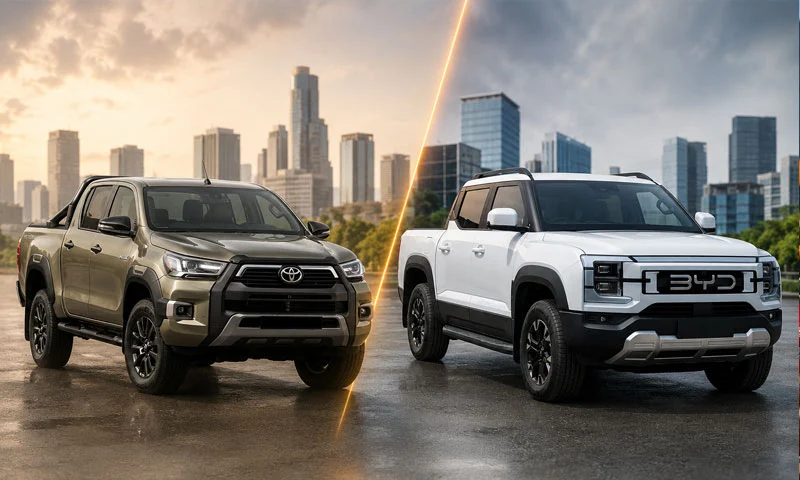
The company said sales of the Toyota Fortuner doubled year-on-year, but the Toyota Hilux faced pressure in urban areas because of newer Chinese rivals, including the BYD Shark 6.
Management added that rural demand for the Hilux remained relatively stable.
Toyota explains Fortuner price cut and localization strategy
The company clarified that the recent reduction in Fortuner prices did not represent a traditional discount campaign.
Toyota management said government tax reductions contributed 60% to 70% of the cut, while localization-led savings reduced costs further.
The company stated, “This was not a conventional discount but a structural cost change.”
Localization levels for the Toyota Corolla, Toyota Yaris and Toyota Corolla Cross now exceed 60%. Localization in the Hilux and Fortuner segment has increased from 38% to more than 41%.
Read More: Suzuki Fronx Price Revealed: Offers Hybrid Power At A Surprising Price
Toyota said these improvements allowed the company to transfer a 3% cost benefit directly to consumers.Management also announced another Rs1 billion investment for localization development.
The amount adds to nearly Rs3 billion in previously approved investments aimed at strengthening domestic manufacturing.
Market share battle intensifies amid policy uncertainty
Toyota said it still controls more than 50% market share in most segments.
However, the company acknowledged stronger competition in the Corolla Cross category, where its market share stands between 25% and 30%.
Management rejected suggestions that Chinese automakers have significantly weakened Toyota’s overall position.
The company said it gained around 1% market share compared to the previous year. Executives acknowledged earlier market share losses but said many customers returned to Toyota after evaluating competing brands.
Institutional sales, including government and corporate buyers, account for roughly 20% of total company sales.
Toyota also highlighted sharp fluctuations in used imported vehicles.
Read More: Nishat Brings iCaur EV SUVs to Pakistan in Bold Market Move
Pakistan imported 36,053 used cars between July 2025 and March 2026. Imports dropped sharply to 793 units in March because of disruptions linked to the US-Iran conflict.
The company said uncertainty surrounding Pakistan’s upcoming Auto Policy continues to affect long-term planning.
The current policy expires on June 30, 2026, while negotiations between automakers and the government over incentives remain unresolved.
Toyota warned that current price reductions may reverse if costs increase after the federal budget.