
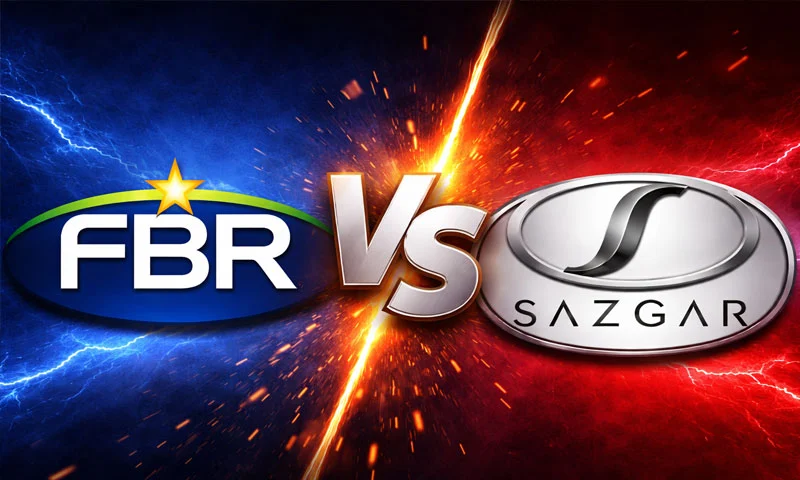
The Federal Board of Revenue (FBR) has issued a tax demand of Rs 188.9 million (Rs 188,902,192) against Sazgar Engineering Works Limited, a major Pakistani automotive manufacturer, in a move that has captured industry attention. The demand relates to the Tax Year 2023 and was created through an order issued on September 30, 2025, under Section 122(5A) of the Income Tax Ordinance, 2001 by the Additional Commissioner Inland Revenue (ACIR).
Sazgar reported the tax notice in its Quarterly and Half-Yearly Financial Statements submitted to the Pakistan Stock Exchange (PSX) on February 4, 2026, but said it has not made any provision for the amount in its books yet, as it is formally contesting the demand.
Read More: Pakistan’s First Locally Assembled Electric Vehicle Enters Volume Production
According to company disclosures, Sazgar has filed both a rectification application under Section 221 of the Income Tax Ordinance and an appeal with the Commissioner Inland Revenue (Appeals). The firm expressed confidence that these legal steps will lead to a favourable outcome, minimizing any long-term impact on its financial position.
Sazgar Engineering Works Limited, founded in 1991 and publicly listed since 1994, is one of Pakistan’s leading manufacturers of automobiles, automotive parts, and household electric appliances. Its shares trade on the PSX, which lists hundreds of companies across various sectors.
Read More: Honda Atlas Bounces Back Strongly as Profits More Than Double in FY26
The tax demand comes amid what many in Pakistan’s automotive industry see as challenging economic conditions. Auto manufacturers have faced fluctuating demand, cost pressures and new levies in recent budget cycles. Earlier in 2025, Sazgar absorbed an additional government levy under the New Energy Vehicles Adoption Levy Act without passing the cost on to customers. The company decided to keep vehicle prices unchanged despite rising input costs and new taxes, a move it described as customer-friendly while others in the sector adjusted prices upward.
Industry watchers say this FBR action highlights the scrutiny that large manufacturers face from tax authorities as Pakistan looks to broaden its revenue base. The FBR has recently been active in enforcing tax demands across sectors, a trend that has also drawn concerns from the textile industry, which urged the authority to delay super tax recovery until broader issues are resolved.
Read More: New CEO at Hinopak: What Tomohiro Oshita’s Appointment Means for Pakistan’s Commercial Vehicles
Despite the tax challenge, Sazgar reported strong earnings for the first half of fiscal 2026, with profits exceeding Rs 8.4 billion and a significant interim dividend approved. These results reflect resilient demand and improving production performance even as regulatory pressures persist.
As the dispute plays out, investors and industry stakeholders will watch closely to see if the tax issue leads to broader changes in corporate taxation or dispute resolution for Pakistan’s industrial sector.