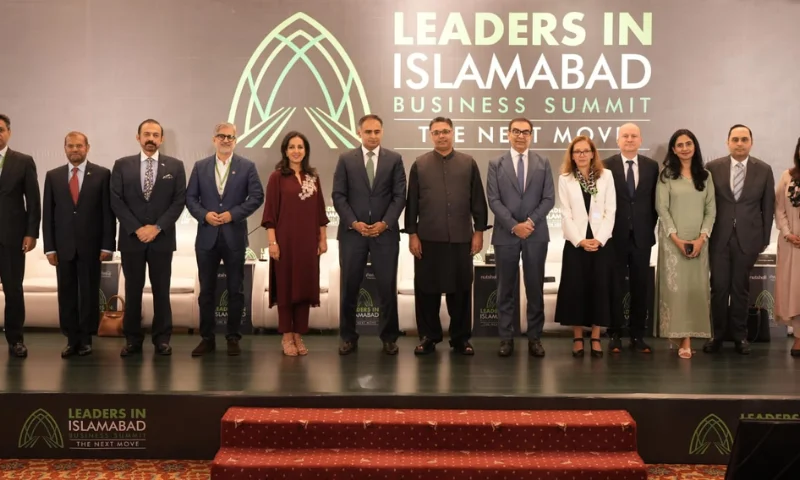
Ministers and business leaders called for stronger exports, technology development and structural reforms as the Leaders in Islamabad Business Summit concluded on September 17.
The ninth edition, themed “The Next Move,” focused on converting Pakistan’s economic potential into sustained competitive advantage. Participants examined economic policy, investment, digital transformation and the country’s global positioning.
Aurangzeb urges shift beyond consumption
Finance Minister Senator Muhammad Aurangzeb said economic momentum had continued into the current fiscal year.
“We had about 3.7% GDP growth last fiscal year, and the momentum is continuing into this fiscal year. Large-scale manufacturing has turned around, while strong remittance inflows and IT exports are supporting the external account.”
He called for moving beyond consumption-led expansion towards sustainable, productive growth.
Read More: PSO Appoints Abdus Sami as Interim CEO After Leadership Move to K-Electric
The emphasis follows Pakistan’s efforts to restore investor confidence and return to international capital markets. Reuters reported in July that US Treasury Secretary Scott Bessent welcomed Islamabad’s reform progress and economic self-reliance agenda.
Privatisation adviser Muhammad Ali urged Pakistan to develop technology rather than simply consume it.
“Our ambition is to have productive businesses at a scale that compete with global entities.”
He advocated stronger education, equal workforce participation and skills for manufacturing, defence and emerging technologies. He also called for more productive cities and better opportunities for young people.
Governance, exports and access to finance
Minister of State for Finance and Railways Bilal Azhar Kayani stressed coordination between federal and provincial authorities.
“We need to break away from the cycle of spending ungoverned and then turning towards IMF loans. We need to increase exports to develop.”
Kayani linked effective policymaking to private-sector consultation. He cited last year’s super-tax reductions, financing for agriculture and small businesses, and reforms at SMEDA.
Former caretaker prime minister Senator Anwar-ul-Haq Kakar urged policymakers to examine structural constraints rather than attribute weak growth solely to terrorism.
“Other countries facing serious violence have continued to build large export economies.”
Climate Change Minister Senator Dr Musadik Malik called for policy continuity, merit and a level playing field.
“Policies based on elite capture always result in exploitation.”
He urged authorities to remove obstacles facing university graduates and support opportunities based on skills.
Technology and capital shape discussions
The summit’s six sessions covered geopolitics, geoeconomics, business competitiveness, artificial intelligence, digital transformation and capital mobilisation. The closing discussion, “Pakistan’s Moment of Choice,” examined the country’s strategic and economic choices.
Participants discussed investment confidence, climate resilience, new markets, productivity and customer experience. Financial discussions addressed domestic and international investment and stronger capital markets.
Read More: Mobilink Bank Becomes Microfinance Leader with Historic PKR 3.62B Profit
Speakers included ACCA’s Lucia Real Martin, IFC’s Simon Andrews, UNDP’s Dr Samuel Rizk and JazzWorld CEO Aamir Ibrahim. Executives from VEON, Telenor, Systems Limited, SAP, PTCL, banks and investment firms also participated.
Organisers presented speakers with Syed Babar Ali: A Centennial Tribute, authored by Nutshell Group founder Muhammad Azfar Ahsan.
The summit closed with calls to act on available reforms, financing, technology and partnerships rather than wait for certainty.