


Researchers from Government College University (GCU) Lahore and the Lahore University of Management Sciences (LUMS) have secured £10,000 in UK funding. The grant will support plans to establish Pakistan’s first Sustainable Chemistry Laboratory, combining chemical recycling, greener teaching practices and staff training.
The UK’s Royal Society of Chemistry (RSC) selected the proposal among 23 projects worldwide under its 2026 Sustainable Laboratories Grants programme. The planned facility at GCU Lahore will focus on reducing waste and developing practices that other Pakistani institutions can adopt.
Dr Muhammad Altaf, an associate professor at GCU’s Institute of Chemical Sciences, and Hasan Yaqoob, a doctoral researcher at LUMS, lead the initiative. Researchers from Queen Mary University of London and the University of Education also form part of the collaboration.
Recovering chemicals for reuse
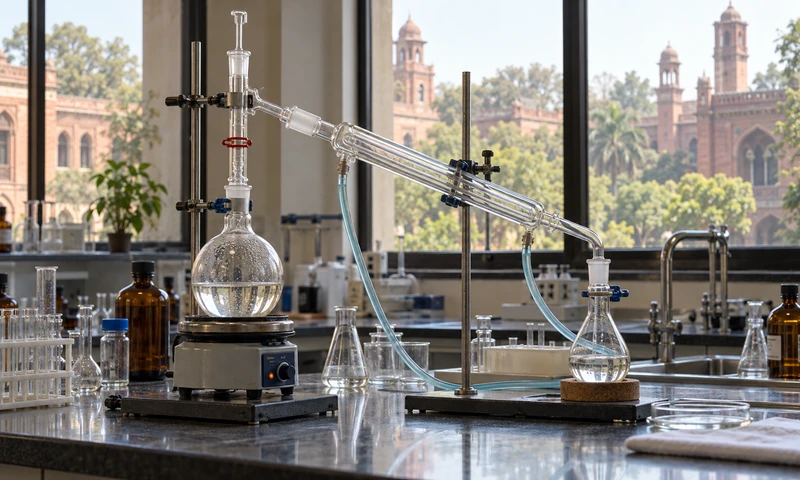
The laboratory will introduce closed-loop solvent recovery and micro-distillation systems to recover chemicals from experiments. These systems will allow laboratory teams to purify and reuse solvents instead of discarding them after use.
Solvents help dissolve substances during laboratory work, making their recovery an important part of the proposed waste-reduction effort. The project will pair this equipment with changes to everyday laboratory practices.
Read More: From Lab to Loom: How India’s Silk Industry Is Reinventing Itself
Undergraduate teaching will also feature greener solvents, bringing sustainability into practical chemistry classes. This will give students experience with environmentally responsible laboratory methods during their university education.
Laboratory staff will receive certified training covering safety and sustainable working practices. Together, these measures address equipment, teaching and the people responsible for running the facility.
A model for Pakistani universities
Dr Altaf said the initiative aims to reduce the environmental impact and resource waste associated with conventional research laboratories.
He said the longer-term objective involves developing an efficient, environmentally friendly laboratory model for universities and research institutions across Pakistan.
The RSC’s official project listing also identifies national replication as a central goal. It describes a model that combines solvent recovery, greener teaching solvents and certified safety training.
The ambition therefore extends beyond establishing a single facility. The researchers want other institutions to adopt the approach, widening its potential benefits across Pakistan’s academic and research laboratories.
Part of a global funding programme
The award forms part of the third and final funding round of the RSC’s three-year Sustainable Laboratories Grants programme. This round allocated more than £200,000 to 23 projects across 10 countries, with individual awards reaching £10,000.
Read More: Pakistan’s Zuma Eyes UK Expansion With Digital eSIMs and Physical SIMs
Since launching the scheme in 2023, the RSC has awarded more than £750,000. Its sustainable laboratories programme funded 82 projects between 2024 and 2026, covering areas including water consumption, energy, plastics and chemical use.
For the Pakistani team, the immediate focus remains practical: recovering solvents, improving undergraduate laboratory teaching and training staff. The wider goal is to turn those changes into a workable model that institutions elsewhere in the country can follow.

























