


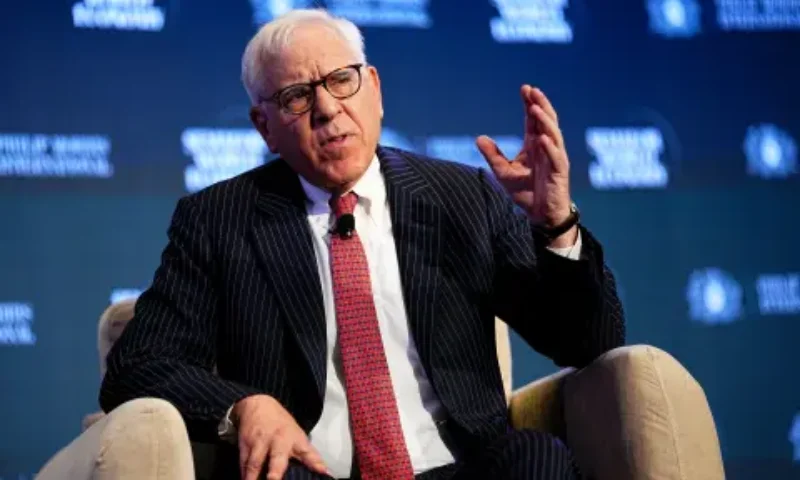
Billionaire investor David Rubenstein has urged young workers to strengthen their reading, writing and speaking skills as artificial intelligence reshapes careers. The Carlyle cofounder says those abilities will remain essential despite growing reliance on chatbots.
“For a young person, the best thing to do is: Learn how to read and enjoy reading, learn how to speak effectively and persuasively, and learn how to write reasonably well,” Rubenstein said.
The 77-year-old also encouraged workers to pursue fulfilling careers. His advice was to “find something that you really enjoy and make it your life’s work.”
“Nobody ever won a Nobel Prize hating what they do,” he said.
Human judgment still matters
Rubenstein acknowledged that professionals increasingly use AI to read and write. However, people still need judgment to distinguish strong writing from poor work.
“I just think the basic skills that have gotten people to be successful over the last several thousand years are probably not going to go away,” he said.
Read More: University of Amsterdam Opens Six Paid PhD Positions Across Five Projects
His comments reflect a wider debate about workplace skills. Employers increasingly expect familiarity with AI tools. Business leaders also emphasise communication, curiosity and independent thinking.
Reading remains a habit among prominent executives. Warren Buffett has said he spent 80% of his working days reading. Jamie Dimon reportedly reads five newspapers before starting work.
AI founders highlight humanities
Anthropic president and cofounder Daniela Amodei has made a similar case for humanities education. She highlights emotional intelligence and the ability to work with others.
“I actually think studying the humanities is going to be more important than ever,” Amodei said.
“The ability to have critical thinking skills and learn how to interact with other people will be more important in the future, rather than less.”
Fellow Anthropic cofounder Jack Clark credits his English literature and creative writing background with supporting his AI career. He emphasises asking useful questions and connecting ideas across disciplines.
“I’m a literature graduate, and I don’t think you’d put that as a cofounder of a frontier AI company, but what turned out to be useful is that I got to learn a lot about history and a lot about the kind of stories that we tell ourselves about the future,” Clark said.
“That’s turned out to be, like, extremely relevant for AI in a way that I think people wouldn’t have predicted.”
Critical thinking needs practice
Microsoft chief scientist Jaime Teevan also sees value in liberal arts education. Natural-language AI tools require users to communicate context and intent.
She highlights flexibility, adaptability, experimentation and questioning assumptions.
“Developing critical-thinking skills requires friction, doing things that are hard, doing deep thinking,” Teevan said.
Read More: GCU, LUMS Win UK Funding for Pakistan’s First Sustainable Chemistry Lab
“For that, a traditional liberal-arts education is really important.”
Employer research supports the broader emphasis on judgment. The World Economic Forum’s Future of Jobs Report 2025 identifies analytical thinking as employers’ leading core skill. Seven in 10 surveyed companies consider it essential. Resilience, flexibility and agility follow, alongside leadership and social influence.

























