


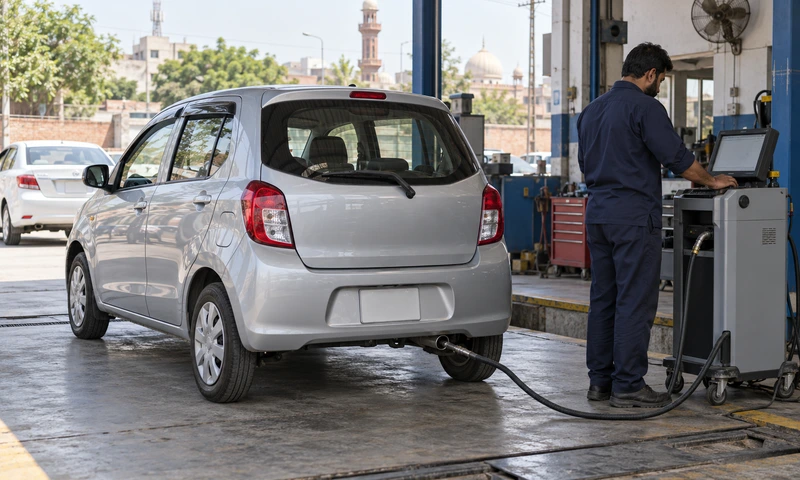
Punjab’s Provincial Transport Authority has clarified which private cars qualify for temporary exemptions from fitness certification, linking eligibility to engine capacity and age.
The clarification means newer cars do not need certificates immediately. Owners must arrange testing once their vehicles reach the relevant threshold, which ranges from five to seven years after manufacture. Each certificate remains valid for one year after testing.
Which cars qualify for an exemption?
The notice sets the following schedule:
| Engine capacity | Certification becomes mandatory | Certificate validity |
|---|---|---|
| Up to 1,000cc | Five years after manufacture | One year |
| 1,001cc to 2,000cc | Six years after manufacture | One year |
| Above 2,000cc | Seven years after manufacture | One year |
For example, a three-year-old 1,000cc car remains within its initial exemption period. Once it reaches the five-year threshold, its owner must obtain certification.
The same principle applies to larger engines, with longer initial exemption periods. None of the three categories receives a permanent exemption.
Owners must renew certification annually after their cars enter the mandatory testing cycle. The one-year validity applies to the certificate, separately from the initial age-based exemption.
Manufacturing date determines eligibility
The notice calculates vehicle age from manufacture, rather than purchase. This distinction matters particularly for people buying used cars.
Buying an older vehicle does not restart its exemption period. A recently purchased car may already need certification if its manufacturing date places it beyond the relevant threshold.
Owners should therefore check both engine capacity and manufacturing details before arranging an inspection. Those whose cars meet the age requirement should visit an authorised Provincial Vehicle Inspection and Certification System centre.
Published reports place the start of enforcement on October 15, 2026. The authority announced a 30-day compliance period in September before action against vehicles lacking required certificates.
Testing fees and booking arrangements
Private-car testing is done within Punjab’s wider effort to reduce vehicle emissions ahead of winter smog. Testing fees range from Rs500 to Rs2,000, depending on engine capacity.
Cars up to 1,000cc attract a Rs500 fee. The charge rises to Rs800 for engines above 1,000cc and up to 1,500cc.
Engines above 1,500cc and up to 2,500cc carry a Rs1,000 fee, according to the guide. Higher-capacity categories attract charges of Rs1,500 or Rs2,000.
The guide describes exhaust-emissions testing at authorised centres and annual certification for vehicles that pass. Owners should confirm their centre’s current arrangements before travelling.
Booking availability may also affect planning. During checks for this report, inspection operator Auto Aeon’s website said it was fully booked and temporarily unavailable for online appointments.
The operator said online booking would reopen soon, without specifying a date. Its notice concerns appointment availability and does not announce any change to the reported enforcement timetable.

























