
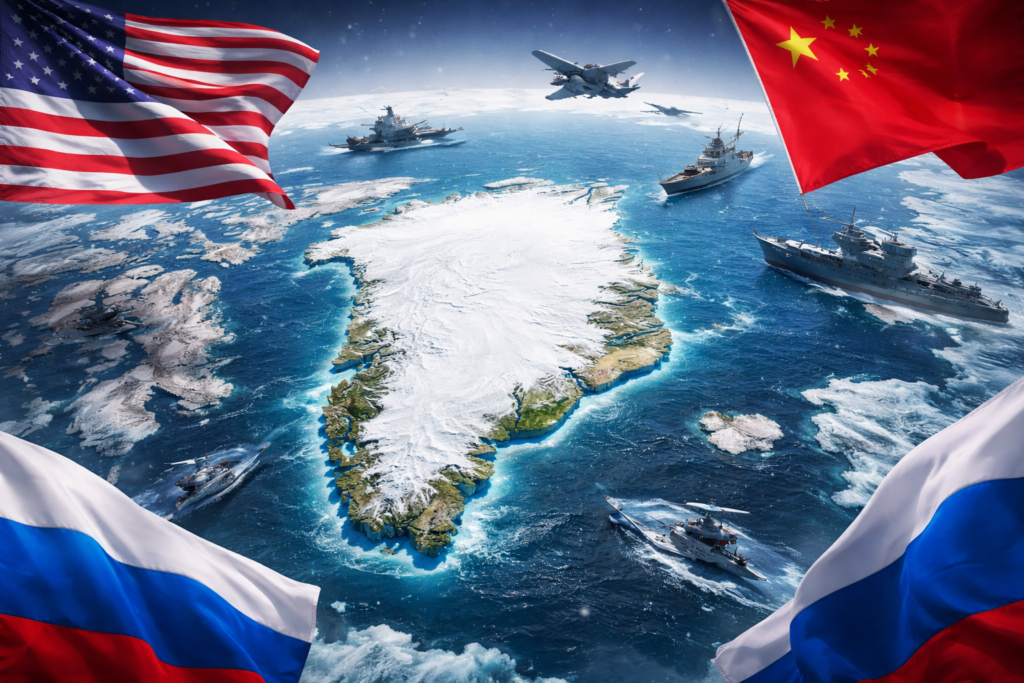
Greenland has emerged as an unlikely but critical focal point in global geopolitics, drawing the attention of the United States, Russia, and China. While it is sparsely populated and largely covered in ice, the world’s largest island holds strategic value far beyond its size — a fact increasingly shaping international competition in the Arctic.
Recent remarks by US President Donald Trump have once again thrust Greenland into the spotlight. Trump has repeatedly argued that the United States must ensure Greenland does not fall under the influence of rival powers, particularly Russia and China, warning that losing ground in the Arctic would threaten American security interests.
Greenland isn’t a joke anymore.
“Easy way or hard way.”
That’s not talk.
That’s intent.
Who blinks first?• Does Denmark concede expanded U.S. basing rights?
• Does Greenland block cooperation and escalate?
• Does NATO formalize Arctic security guarantees?
• Does China… pic.twitter.com/AUrf9Lj1rf— BRKT 👑 (@BRKTgg) January 10, 2026
But the strategic interest in Greenland did not begin with political rhetoric. It is rooted in geography, security, and resources.
A Strategic Arctic Crossroads
Greenland sits at a vital junction between North America and Europe, overlooking key air and sea corridors in the North Atlantic and Arctic. As climate change continues to reduce ice coverage, the Arctic is becoming more accessible, increasing its importance for shipping routes, military movement, and surveillance. Control or influence over Greenland offers a commanding position in this rapidly evolving region.
A Pillar of US Defence
The United States already maintains a long-standing military presence in Greenland through the Pituffik Space Base, a critical installation for missile detection, space monitoring, and early-warning systems. This base forms part of the broader North American defence shield and plays a role that cannot easily be replicated elsewhere. For Washington, Greenland is not just territory — it is a cornerstone of strategic defence planning.
Russia and China’s Growing Arctic Interest
Russia has steadily expanded its Arctic military infrastructure, reopening Cold War-era bases and increasing patrols along northern routes. China, meanwhile, has adopted a long-term economic and scientific approach, declaring itself a “near-Arctic” stakeholder and investing in research, infrastructure projects, and potential future shipping lanes linked to its global trade ambitions.
While China has no territorial claims in the Arctic, Western analysts increasingly view its presence as part of a broader strategy to secure influence over future trade routes and critical resources.
Hidden Wealth Beneath the Ice
Greenland is believed to hold significant reserves of rare earth minerals and other critical resources essential for modern technologies, renewable energy systems, and defence industries. As countries seek to reduce dependence on limited supply chains, Greenland’s resource potential has become increasingly attractive — despite the high costs and environmental challenges of extraction.
Sovereignty Still Matters
Despite external interest, Greenland remains a self-governing territory within the Kingdom of Denmark, and its leaders have firmly rejected the idea that the island is open for acquisition or external control. Greenlandic officials have consistently stressed that decisions about the island’s future will be made by its people, not foreign powers.
The Bigger Picture
Greenland’s rising profile reflects a larger shift in global power dynamics. As the Arctic transitions from a frozen frontier to a contested strategic zone, competition among major powers is intensifying. Geography, defence, resources, and climate change have combined to transform Greenland from a remote landmass into a geopolitical prize.
Whether through diplomacy, defence cooperation, or economic engagement, one reality is clear: Greenland is no longer on the margins of global politics — it is firmly at the centre of a new Arctic rivalry.