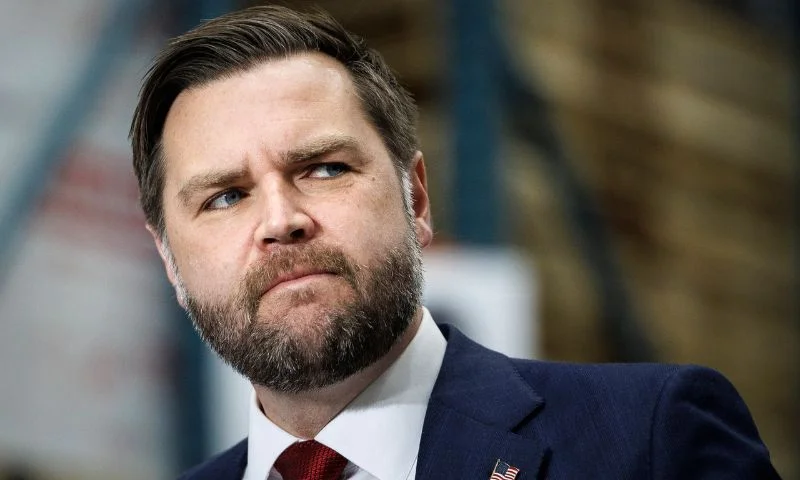
US Vice President JD Vance delivered an unusually sharp message to Israeli critics of the newly signed US-Iran memorandum of understanding (MoU), urging them to stop attacking Washington’s efforts and warning that Israel should not alienate its strongest ally.
Speaking during a White House press briefing on Thursday, Vance responded to criticism from Israeli lawmakers and officials who oppose the framework agreement reached between Washington and Tehran.
“If I was in the cabinet of the Israeli government, I might not be attacking the only powerful ally that I have anywhere left in the entire world,” Vance told reporters.
“Anybody in Israel who thinks their biggest problem is the president of the United States needs to wake up and smell the reality of the situation.”
The remarks highlighted growing friction between Washington and Tel Aviv after President Donald Trump signed an agreement aimed at ending the conflict with Iran and reopening the Strait of Hormuz. The deal came after months of regional tensions and intensive diplomacy.
Under the framework, the United States and Iran agreed to end hostilities, restore navigation through the strategically important waterway, and begin a 60-day period of technical negotiations on a broader settlement. Vance confirmed the 60-day clock officially started on Thursday.
Verification at the Centre of the Agreement
The deal has drawn criticism from Israeli politicians and some Republican lawmakers who argue that it offers Iran sanctions relief and economic incentives without clearly dismantling its nuclear programme.
Questions have also emerged over provisions linked to oil exports, sanctions relief and a proposed $300 billion reconstruction package for Iran. Critics say the framework lacks a firm mechanism for eliminating Tehran’s nuclear capabilities.
Vance rejected those concerns and stressed that Iran would receive benefits only after proving compliance.
“If they don’t perform as we’ve said before, they don’t get any of the benefits of the bargain,” he said.
“There’s a lot of discussion, the MoU, the gentleman’s agreements, the final deal. Words don’t matter, ladies and gentlemen, we’re about verification.”
JD Vance is warning Benjamin Netanyahu’s administration not to mess around with the United States, saying they may end up losing everything.
Vance says Trump is their last ally because the entire world already hates them.
"If I were in the cabinet of the Israeli government, I… pic.twitter.com/l3kRzQiov4
— Shadow of Ezra (@ShadowofEzra) June 18, 2026
The vice president said oil prices were already declining and noted that the US had started implementing its commitments under the agreement.
“The US military has allowed north of a dozen ships to go through our naval blockade, and so we’re also honouring our end of the early part of the agreement,” he said.
Reports indicate that the United States has lifted restrictions that previously affected Iranian maritime trade, while commercial traffic has resumed through the Strait of Hormuz.
Switzerland Talks and Political Stakes
Vance also revealed plans to travel to Switzerland for the next phase of negotiations.
“I plan to go to Switzerland. I suspect this weekend, but I’m not sure. It just depends on exactly when the Iranians can get there.”
The vice president has emerged as the administration’s chief advocate for the agreement. His growing role places him at the centre of one of the most consequential foreign policy initiatives of Trump’s second term.
Political observers view the assignment as a high-risk test for Vance, who is widely seen as a potential Republican contender in the 2028 presidential election. Success could strengthen his credentials as a foreign policy leader. Failure could expose him to political fallout.
Trump recently joked that he would blame Vance if the agreement collapsed. Asked about the remark, Vance brushed it aside.
“I mean, I think the president was joking, as he often does.”
“But, no, look, the entire team has worked very well on this, and we’ve got this thing to a very good place for the American people.”
The comments came as divisions between Washington and some members of Israel’s government became increasingly visible. Recent reports indicate that Trump and Israeli Prime Minister Benjamin Netanyahu have disagreed over the direction of diplomacy with Iran and broader regional security issues.