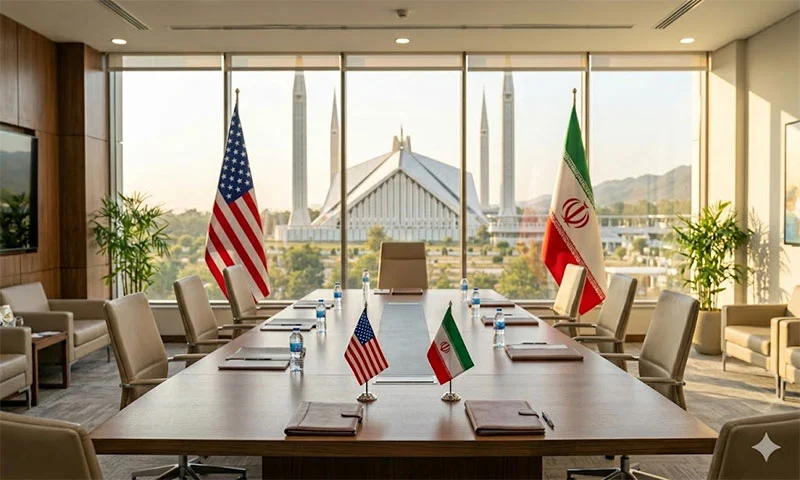
The United States and Iran are considering a second round of high-level talks aimed at ending their six-week conflict, with Pakistan once again emerging as a potential host as diplomatic efforts intensify ahead of the ceasefire deadline.
Officials familiar with the discussions said both sides are exploring the possibility of new in-person negotiations, with Islamabad and Geneva under consideration as venues. While no final decision has been made on timing or location, sources indicated the talks could take place as early as Thursday.
A diplomat from one of the mediating countries said Tehran and Washington had agreed in principle to another round, though US officials cautioned that discussions were still ongoing. All sources spoke on condition of anonymity due to the sensitivity of the negotiations.
US President Donald Trump signalled a possible breakthrough earlier, telling reporters, “we’ve been called by the other side” and “they want to work a deal.”
Pakistan pushes for fresh talks in Islamabad
Pakistan has formally proposed hosting a second round of negotiations in Islamabad in the coming days, according to officials aware of the development. The proposal is aimed at sustaining diplomatic momentum following the first round of talks, which ended without a formal agreement but were described as part of an ongoing process.
One Pakistani official said the initial discussions should not be viewed as a one-off effort, adding that continued engagement was necessary to bridge differences between the two sides.
Diplomatic sources said Pakistan’s role as a facilitator has been widely acknowledged, with Islamabad positioning itself as a neutral venue for dialogue amid heightened regional tensions.
Key differences remain over nuclear issue
Despite signs of renewed engagement, significant gaps remain between Washington and Tehran, particularly on Iran’s nuclear programme. Reports suggest Iran has proposed suspending uranium enrichment for up to five years, while the United States has pushed for a much longer freeze.
The proposals were discussed during the Islamabad talks, but officials said both sides remain far apart on reaching a final agreement. There has been no official confirmation of the reported offer, though diplomatic channels remain active.
US Vice President JD Vance said the earlier negotiations had yielded some progress on key issues. “They moved in our direction,” Vance said, referring to Iranian negotiators. He added that discussions had focused on the removal of nuclear material and mechanisms to ensure uranium enrichment does not resume in the future.
“We’ve made clear that we absolutely need to see the nuclear material come out of the country of Iran…the ball is in the Iranians’ court because we put a lot on the table.” — VP Vance pic.twitter.com/s4Ki2HqL4U
— Vice President JD Vance (@VP) April 14, 2026
However, Vance acknowledged that Iranian negotiators may need approval from authorities in Tehran before any deal can be finalized. “There really is, I think, a grand deal to be had here. But, it’s up to the Iranians, I think, to take the next step,” he said.
Diplomatic window narrows as ceasefire deadline approaches
The push for a second round of talks comes as the current ceasefire is set to expire next week, increasing urgency for both sides to reach a broader understanding that could prevent a return to hostilities.
International observers say the willingness to continue negotiations reflects a shared interest in avoiding escalation, even as deep mistrust persists. Reports indicate that discussions remain fluid, with mediators working to align positions on key sticking points.
While uncertainty remains over whether a breakthrough can be achieved, the prospect of renewed talks has kept diplomatic channels open, offering a potential path toward de-escalation.