

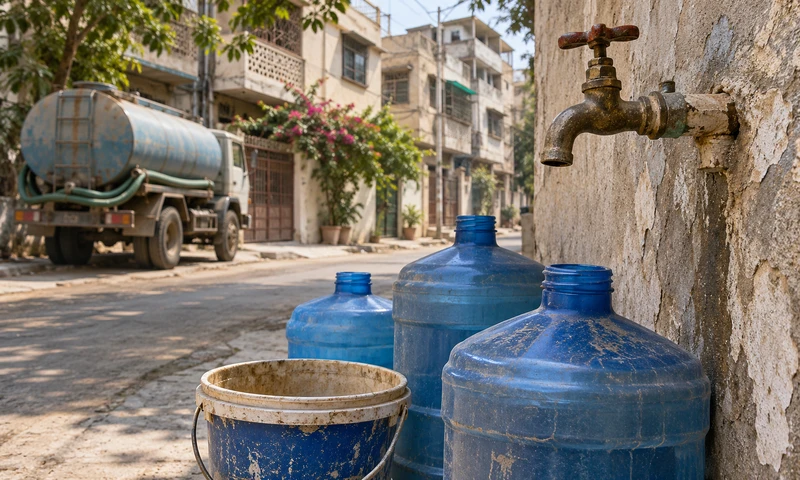
A power cable fault at the Gharo Pumping Station has halted supplies from the facility to Karachi, threatening a 14-million-gallon shortfall. The disruption adds to a month-long water crisis that has forced residents in several neighbourhoods to depend on costly tankers.
A Karachi Water and Sewerage Corporation (KWSC) spokesperson said the fault interrupted electricity to three facilities. These include the Gharo New Pump House, Gharo Old Pump House and the filtration plant, bringing pumping operations to a temporary halt.
Areas facing water supply disruption
The disruption threatens supplies to Port Qasim, Bin Qasim Town, Shah Faisal Town, PNS Mehran, PAF Base Faisal and Karsaz.
The spokesperson said KWSC officials remained in constant contact with K-Electric management to secure electricity restoration and restart pumping.
Gharo normally supplies around 30 million gallons of water daily to Karachi. However, officials estimated that the latest interruption would cause a shortfall of approximately 14 million gallons.
KWSC put its normal citywide supply at around 650 million gallons daily. During the disruption, other sources and pumping facilities continued delivering approximately 536 million gallons, according to the corporation.
Officials did not explain the full difference between those citywide figures. The reported Gharo shortfall alone does not account for the gap between normal supply and the current volume.
The spokesperson said supplies from Gharo would return to normal once electricity resumed. A K-Electric spokesperson said technical teams were working to rectify the fault. Neither utility provided a firm restoration deadline in the available reports.
Month-long shortages strain households
The latest breakdown comes as residents elsewhere in Karachi continue reporting severe shortages that predate the Gharo outage.
In Gulshan-e-Iqbal, complaints cover Blocks 13-A, 13-B, 13-C, 13-D, 13-D1, 13-D2, 2, 4 and 5. Residents of Tariq Road, Delhi Mercantile Society, Korangi and Landhi also face acute supply problems.
Residents said the water utility had failed to restore regular deliveries despite shortages lasting more than a month. They blamed repeated pumping-station power failures and pipeline problems for worsening the situation.
For households already purchasing tanker water, another interruption adds pressure to budgets while leaving the timing of regular supplies uncertain.
Supply gap leaves little room for breakdowns
Karachi’s water network already operates against a substantial demand deficit. A KWSC planning presentation placed the city’s 2024 demand at 1,200 million gallons daily, against supplies of 650 million gallons.
That historical assessment illustrates the scale of the underlying shortage, although it does not establish Karachi’s current demand. The same document listed additional bulk-water schemes among the corporation’s planned measures to improve availability.
For now, the immediate relief depends on repairing the electrical fault and restarting Gharo’s pumps. Residents across the affected localities meanwhile face further uncertainty as the city struggles with both the latest outage and unresolved neighbourhood shortages.