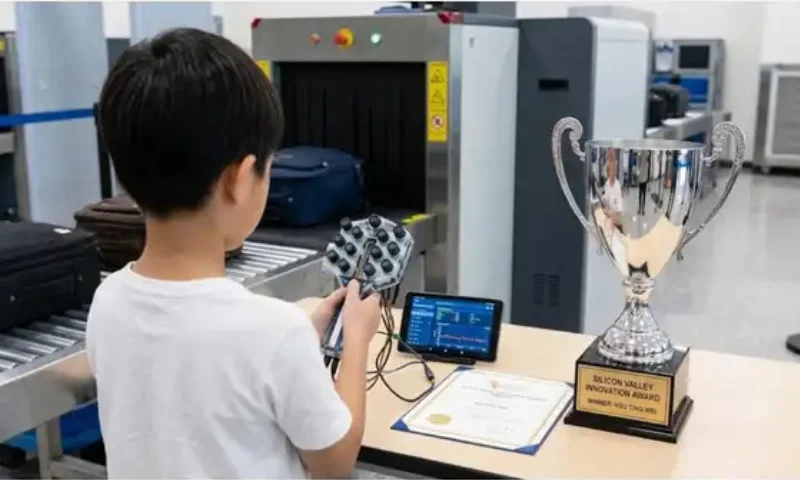
A 10-year-old Taiwanese student has won major international recognition for an AI “electronic nose” that could improve airport baggage screening.
Hsu Ting-wei, a student at Kang Chiao International School, won a gold medal at the 2026 Silicon Valley International Invention Festival in California. He also received the International Federation of Inventors’ Associations’ Best Invention Award.
The festival took place at the Santa Clara Convention Center from August 14 to August 16. Its official programme included exhibitions, judging and an awards ceremony.
AI ‘Electronic Nose’ Could Detect Drugs and Disease Risks
Hsu calls his invention the “Novel Artificial Electronic Nose.”
The contactless security platform combines real-time air sampling, gas chromatography-mass spectrometry and AI-based odor recognition. Authorities could install it behind existing X-ray baggage screening equipment at airports.
The system would analyse airborne chemical traces linked to screened luggage without requiring direct contact with its contents.
Read More: Teen Invents AI Device That Could Treat Crossed Eyes Without Surgery
Hsu hopes the technology could stop pork products carrying African swine fever from entering countries. He also believes it could help US authorities detect drugs such as fentanyl at borders.
Jury chairman Amin Ghafooripour said Hsu received the honour because judges saw practical value in his work.
“Hsu’s award wasn’t handed out simply as encouragement due to his age, but reflected genuine recognition from the jury, who saw real practical value in the invention and were left with a strong impression by his work.”
Taiwan Records Strong Showing at SVIIF
Hsu was among several Taiwanese inventors who secured major honours at the event.
The festival attracted participants from more than 30 countries. It featured general inventors alongside young competitors aged seven to 18.
Taiwanese students won the Youth Talent Competition with “AllerDetect GO.” The health system targets children, older adults and people prone to allergies.
It combines allergen detection, alerts, record-keeping and smart-home responses to help users identify possible risks earlier.
A team from the Affiliated Senior High School of National Taiwan Normal University took second prize in the youth competition.
Baichao Greenergy Tech Co also received a special award from the World Intellectual Property Organization in the general inventors category.
Taiwan finished the festival with 24 gold medals, eight silver medals and one bronze from 35 entries. The 24 gold medals marked Taiwan’s highest total since it first participated in SVIIF in 2018.
Young Inventors Draw Praise
SVIIF board committee member Matt Nuccio praised Taiwan’s performance, particularly the work of younger participants.
“Taiwan had quite a few great innovations,” Nuccio said.
He also expressed surprise at the quality of projects produced by inventors at such young ages.
Ghafooripour highlighted another pattern among Taiwanese participants.
Read More: Chinese EV Maker Patents Voice-Controlled Toilet Hidden Under Car Seat
“Ghafooripour added that Taiwanese inventors tended to focus on applying new technologies toward practical solutions aimed at making everyday life easier for people.”
Hsu’s award reflects that approach. His invention combines AI with established chemical-analysis technology to address airport security, disease prevention and illegal drug detection.
It also shows how younger inventors are increasingly using advanced technology to tackle practical public-safety challenges.