

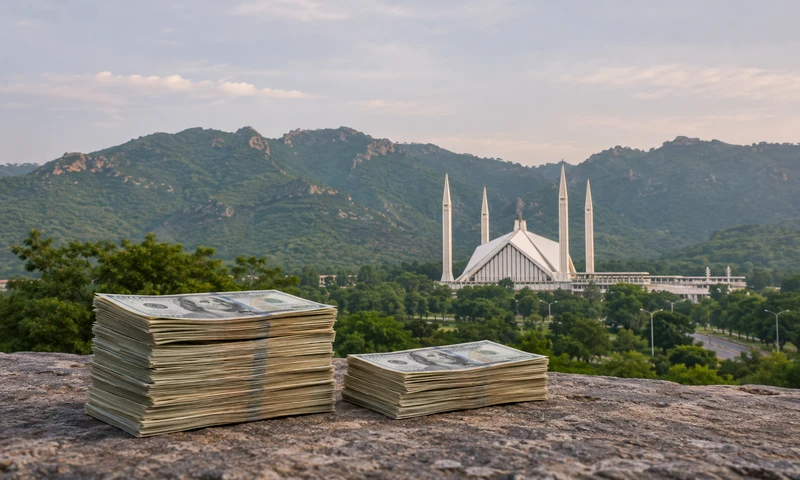
Pakistan’s external debt rose nearly 97 per cent over the decade to 2025, reaching $135.107 billion. The World Bank’s International Debt Report 2026 puts the 2015 figure at $68.673 billion. China remained Pakistan’s largest individual creditor, with $22.4 billion outstanding.
Who holds Pakistan’s external debt?
Public and publicly guaranteed debt accounted for $107.076 billion of the total. Private debt without a public guarantee stood at $17.58 billion, while short-term debt totalled $10.45 billion.
Within the public and publicly guaranteed category, Pakistan owed multilateral creditors $56.83 billion and bilateral creditors $42.43 billion. Private creditors held another $7.8 billion in that category. The World Bank followed China with $19.2 billion outstanding, while the Asian Development Bank held $16.83 billion.
Read More: Pakistan Cuts Interest Payments by 22%, but Its Debt Keeps Growing
Official loans carried an average interest rate of 3.6 per cent, with a 16-year maturity and four-year grace period. Private credit averaged 8.6 per cent interest, with three years for repayment and a one-year grace period.
China extended maturities on $2 billion in Pakistani loans in 2025. The World Bank report puts new IMF disbursements at $2.3 billion across the Extended Fund Facility and Resilience and Sustainability Facility. The IMF’s December review separately put cumulative disbursements under both arrangements at about $3.3 billion.
Debt-service and interest ratios improved across the Middle East, North Africa, Afghanistan and Pakistan region. However, external debt rose from 26.7 to 29.4 per cent of regional gross national income, the largest increase among regions.
Developing economies’ external debt hits $9.4 trillion
External debt across low- and middle-income economies grew 5.5 per cent to a record $9.4 trillion. That marked the fastest rise in four years. A rebound in bond issuance, renewed private lending and a weaker US dollar contributed to the increase. Currency effects accounted for 28.2 per cent of the increase in public and publicly guaranteed debt.
Private creditors held $5 trillion, up 5.2 per cent. Bondholder claims rose 5.7 per cent to $2.4 trillion. Claims held by commercial banks and other private lenders rose 4.7 per cent to $2.7 trillion. Meanwhile, gross national income grew 5.1 per cent.
Read More: Pakistan Wins Panda Bond Award, Plans More Debt Issues in China
Debt rose 8.1 per cent to $1.3 trillion in countries eligible for International Development Association financing. Low-income countries recorded an 8.9 per cent increase to $262.4 billion, their steepest rise since 2020. New private credit for IDA-eligible borrowers averaged 8.2 per cent, the highest since 1989. Their rate gap between official and private credit widened from 3.4 percentage points in 2016 to 5.5 in 2025. Countries eligible only for IBRD lending paid 5.5 per cent on new bonds, down from 5.8 per cent.
Debt-service payments climbed for a fifth straight year, rising 1.9 per cent to $1.4 trillion. Payments to bondholders rose 13.7 per cent to $363.1 billion. From 2022 through 2025, debt service exceeded new financing by $436.1 billion. Even so, net long-term debt flows swung from a $118.4 billion outflow in 2024 to a $45.4 billion inflow in 2025.