
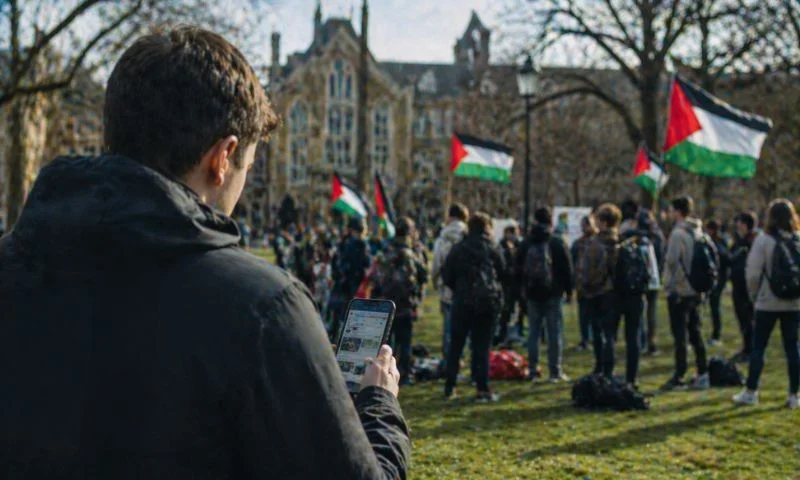
A number of British universities have paid a private security company run by former military intelligence officials to monitor students’ social media activity, raising concerns about surveillance, privacy and academic freedom.
An investigation found that at least 12 universities hired a firm known as Horus to track student protesters and academics, particularly those expressing support for Palestine. The company reportedly analysed social media posts, compiled intelligence reports and conducted background checks on individuals invited to speak on campuses.
The findings highlight how universities turned to external security services amid rising campus protests linked to the war in Gaza and broader political tensions.
Monitoring protests and online activity
According to the investigation, the security firm provided detailed reports on student activism, including online behaviour and affiliations. In one case, it carried out background checks on a Palestinian guest speaker, while in others it tracked the social media presence of student protesters.
Student groups at institutions such as the London School of Economics were among those reportedly monitored, with the firm producing intelligence-style briefings for university administrators.
The surveillance extended beyond physical protests, focusing heavily on digital spaces where students organise and express views.
Universities defend security measures
Universities involved have argued that such monitoring was necessary to maintain campus safety and manage potential disruptions.
They said the use of external security firms was part of broader efforts to assess risks linked to protests and ensure events could proceed without incident.
However, critics say the approach risks blurring the line between safety and surveillance.
Civil liberties organisations have warned that monitoring students’ online activity could have a chilling effect on free speech and discourage political engagement.
Concerns over privacy and academic freedom
The revelations have triggered debate over data protection and the role of universities as spaces for open discussion.
Campaigners argue that outsourcing surveillance to private firms raises serious questions about accountability and the handling of sensitive personal information.
“There are growing fears that universities are acting as extensions of security services,” one rights group said in response to the findings.
Experts note that universities hold large volumes of personal data, and increased monitoring could expose students and staff to misuse of information if safeguards are not strictly enforced.
Part of a wider trend
The use of surveillance measures on campuses is not new, but the scale and sophistication of monitoring appear to be increasing.
Previous investigations have shown that some institutions have monitored student communications or worked with external organisations to track protest activity, particularly in politically sensitive contexts.
Analysts say the latest revelations reflect broader tensions between security concerns and civil liberties in higher education systems.
Growing scrutiny
The report is likely to intensify scrutiny of university policies and their relationships with private security firms.
Students and advocacy groups are calling for greater transparency, clearer guidelines on data use and stronger protections for academic freedom.
As universities continue to navigate politically charged environments, the balance between ensuring safety and protecting individual rights is expected to remain a central issue.