Fresh political upheaval in Venezuela has once again drawn global attention to a striking paradox: the country sitting on the largest confirmed oil reserves on Earth remains largely unable to turn that wealth into economic or energy power.
Oil markets initially braced for disruption following the US removal of Venezuelan leader Nicolás Maduro. Analysts expected instability in Caracas to push fuel prices higher, particularly jet fuel. Instead, oil prices moved lower on Monday, reflecting broader supply dynamics and confidence that global output would remain sufficient.
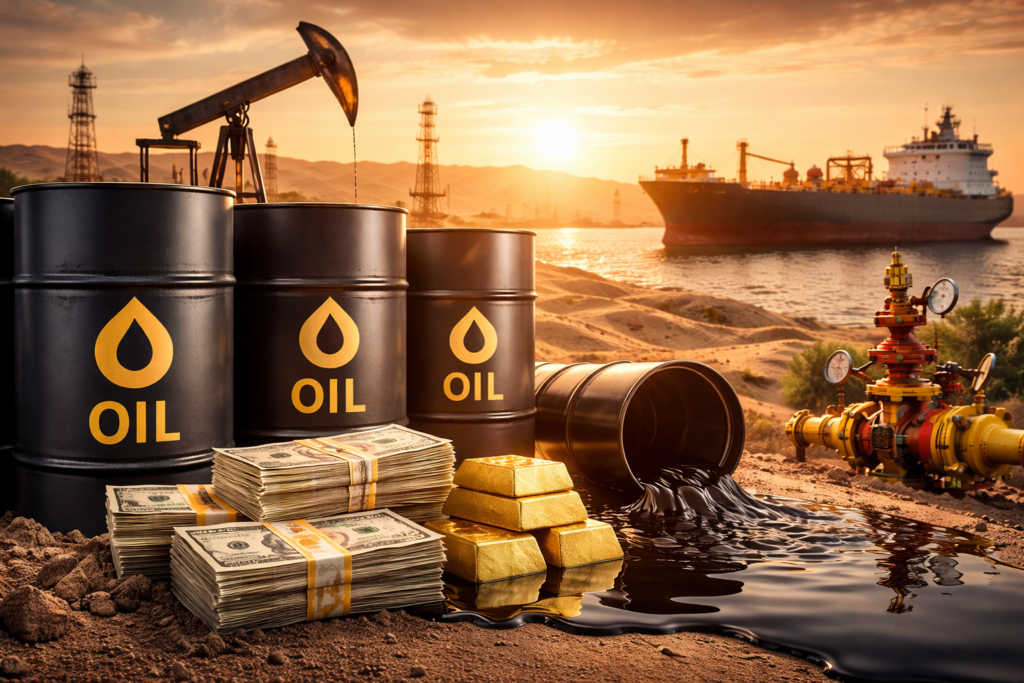
Venezuela’s reserves estimated at 303 billion barrels remain the largest proven stockpile in the world. Yet much of this oil is effectively locked underground, constrained by years of mismanagement, sanctions, underinvestment, and infrastructure decay.
A world rich in oil, but uneven in power
The renewed attention on Venezuela comes alongside a widely circulated list on social media ranking the world’s top countries by confirmed oil reserves. The comparison highlights a fundamental reality of today’s energy landscape: large reserves do not automatically translate into high production.
Oil Reserve Barrels
🇻🇪 Venezuela — 303,200 M
🇸🇦 Saudi Arabia — 267,200 M
🇮🇷 Iran — 208,600 M
🇨🇦 Canada — 163,100 M
🇮🇶 Iraq — 145,000 M
🇦🇪 United Arab Emirates — 113,000 M
🇰🇼 Kuwait — 101,500 M
🇷🇺 Russia — 80,000 M
🇺🇸 United States — 74,400 M
🇱🇾 Libya — 48,400 M
🇳🇬 Nigeria —… pic.twitter.com/oPnbVqUeeM— Evelyn Janeidy Arevalo (@JaneidyEve) January 4, 2026
Venezuela tops the list in terms of proven reserves, yet its current output remains well below historical levels due to long-standing structural and economic constraints. In contrast, some countries with comparatively smaller reserves produce larger volumes of oil, driven by technological methods such as shale extraction and intensive field development.
The disparity underscores a widening divide between nations that hold vast underground resources and those that are able to sustain high levels of production, illustrating how policy, investment, and infrastructure often matter as much as geology in determining energy influence.
OPEC’s dominance — on paper
The list also shows the continued dominance of OPEC members. Collectively, OPEC countries hold close to 1.7 trillion barrels, accounting for more than 60 percent of global proven reserves.
After Venezuela, Saudi Arabia ranks second with around 267 billion barrels. Riyadh retains significant flexibility over supply, producing roughly 9 million barrels per day while coordinating output cuts through OPEC+ to manage prices.
Iran and Iraq follow with approximately 209 billion and 145 billion barrels, respectively. Both countries play critical roles in regional energy flows, despite sanctions, political instability, and infrastructure pressures.
Sanctions, chaos, and market reality
Western sanctions on Venezuela, Iran, and Russia have tightened long-term supply forecasts, particularly looking toward 2026, according to Reuters. However, record output from the US and steady production from Canada and Brazil have helped prevent major shortages.
Energy analysts warn that Venezuela’s instability is unlikely to ease quickly. As a result, markets increasingly rely on Middle Eastern stability and North American abundance to balance global demand.
Beyond oil
The renewed attention on oil reserves comes at a moment when the global energy transition is accelerating. As geopolitical shocks expose the fragility of oil dependence, investment continues to shift toward renewables and diversification.
The lesson from the rankings is clear: oil reserves still matter, but technology, governance, and stability matter more.