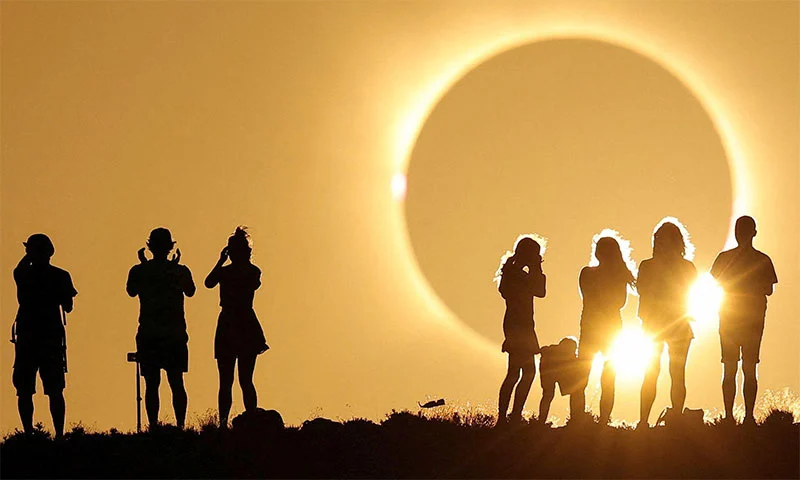
Millions of people across Europe turned their eyes skyward on Wednesday as a total solar eclipse swept across the continent, briefly plunging parts of Spain, Iceland and Portugal into darkness.
The August 12 eclipse began over northern Russia before crossing Greenland, Iceland and the Atlantic. It later reached Spain shortly before sunset. NASA said the path of totality also touched a small corner of Portugal, while much of Europe experienced a partial eclipse.
The path of totality stretched almost 300 kilometres wide. In Spain, it crossed the country from the northwest towards the Balearic Islands, including Mallorca.
Spain Draws Huge Crowds for Rare Eclipse
At Spain’s Ebro Observatory, hundreds watched as the moon completely covered the sun. The black lunar disc appeared surrounded by the glowing solar corona.
Across Europe, spectators responded with applause, cheers, tears and stunned silence. ESA reserve astronaut Sara García Alonso told RTVE: “It was one of the most beautiful things I’ve ever seen in my life. It gave me goosebumps.”
Another spectator at the Ebro Observatory described the eclipse as “very short, but indescribably beautiful.”
A German tourist watching from Mallorca called the experience “absolutely magical” and “crazy to see.” Another visitor said the two-minute spectacle justified flying to Mallorca and driving another 90 minutes.
Cloud and rain obscured much of the eclipse in Reykjavík. Spain enjoyed better conditions despite temperatures nearing 40 degrees Celsius in some areas.
The event also triggered a major travel rush. Visitors arrived from countries including Japan and the United States. Spanish authorities had expected up to 1.5 million additional road journeys, while accommodation in prime viewing areas filled months earlier.
Authorities had also prepared for wildfire risks. In Peñíscola, a vehicle caught fire near an eclipse viewing area and flames spread to 33 other vehicles before firefighters controlled the blaze.
Germany witnessed a deep partial eclipse, with around 90% of the sun obscured in some areas. Crowds gathered in Berlin and on Feldberg mountain, while hot-air balloons floated above Dresden during the event.
Perseid Meteor Shower Follows Eclipse
The celestial show continued overnight as the Perseid meteor shower reached its annual peak.
Viewing conditions were especially favourable because the peak coincided with a new moon. At dark locations, observers could see up to 100 meteors per hour.
Even light-polluted Berlin recorded shooting stars before 11 pm. Zeiss Major Planetarium director Tim Florian Horn said: “Every shooting star is greeted with loud oohs and aahs.”
The Perseids come from debris left by comet 109P/Swift-Tuttle. Tiny particles burn as they enter Earth’s atmosphere, producing bright streaks across the sky. The shower remains active until August 24.
Spain will see another total solar eclipse on August 2, 2027, which will also cross parts of North Africa. Germany, meanwhile, will have to wait until 2081 for its next total solar eclipse, visible only in the far southwest.