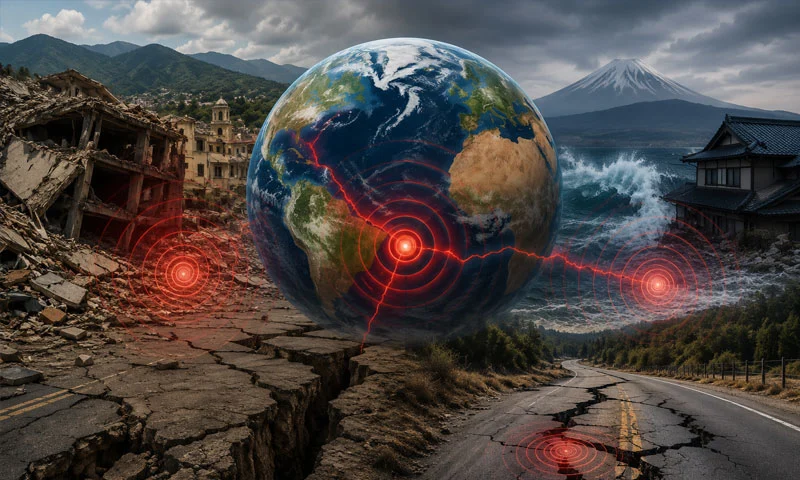
A series of powerful earthquakes reported across Venezuela, Japan and the United States within a span of hours has prompted questions about whether the events were connected. However, according to seismologists and reports citing earthquake experts, there is no scientific evidence linking the tremors.
According to multiple media reports, the strongest activity occurred between June 24 and June 25, when major earthquakes struck parts of Venezuela, Japan and northern California.
The close timing of the events fueled speculation on social media that they might have been part of a wider global geological phenomenon.
Experts, however, say the earthquakes occurred independently in different tectonic settings separated by thousands of kilometres.
Major Earthquakes Reported Across Three Continents
According to reports, the first major earthquake struck near Moron in Venezuela’s Yaracuy state at around 3:34am IST on June 25. The quake measured magnitude 7.2.
Reports said a stronger magnitude 7.5 earthquake struck the same region only minutes later.
Several news outlets described the earthquakes as among the strongest to hit Venezuela in more than a century. They reported collapsed buildings, widespread panic and rescue operations across affected areas.
FUERTE SISMO EN CARACAS VENEZUELA#Sismo #Terremoto #Temblor #Venezuela #earthquake pic.twitter.com/Nxl0EYoBBR
— Tendencia en X HOY (@TendenciaenXHoy) June 24, 2026
Reports also said the earthquakes killed at least 32 people and injured dozens more. Authorities continued rescue operations, and officials warned the death toll could increase.
Roughly 30 to 40 minutes later, according to reports, a magnitude 7.2 earthquake struck off Japan’s Iwate Prefecture in the country’s northeast.
Some reports later revised the magnitude to 6.9 based on updated seismic assessments. Authorities reported strong shaking but no major damage or fatalities.
Earlier on June 24, at about 8:40pm IST, a magnitude 5.6 earthquake reportedly struck near Redwood Valley in Mendocino County, northern California.
According to reports, the California earthquake caused minor injuries and localized power outages but no deaths.
Experts Say Timing Was Coincidental
According to seismologists cited in multiple reports, the earthquakes were not connected despite occurring within hours of each other.
Experts explained that Venezuela sits along the boundary between the Caribbean and South American tectonic plates, where the plates slide past one another.
Japan lies on the Pacific Ring of Fire, one of the world’s most active seismic zones, where the Pacific Plate subducts beneath surrounding plates.
California’s earthquake, meanwhile, originated within the San Andreas Fault system.
Scientists said a major earthquake can produce extremely small stress changes on distant faults around the world. However, those changes are generally far too weak to trigger another earthquake thousands of kilometres away.
Experts also noted that earthquakes measuring magnitude 6 or higher occasionally occur on the same day without sharing a common cause.
According to researchers quoted in the reports, Earth experiences thousands of earthquakes every day. Most are too small for people to notice.
They added that there is no credible scientific evidence of a global triggering mechanism connecting these reported earthquakes.
Instead, experts described the near simultaneous timing as a coincidence rather than a coordinated geological event.
Scientists are expected to continue studying the reported earthquakes, particularly the Venezuela sequence, to better understand their characteristics and long-term implications. However, based on current scientific understanding, experts say the events do not indicate a linked worldwide seismic phenomenon.