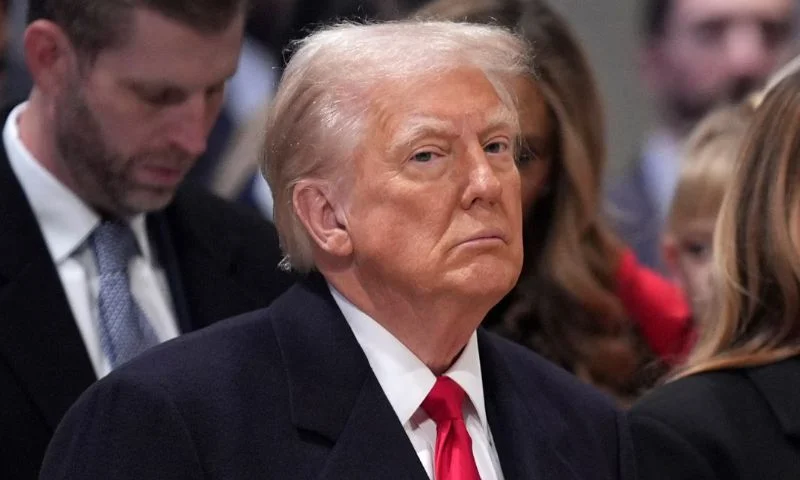
US President Donald Trump on Tuesday brushed aside a congressional resolution seeking to end American military involvement in Iran, calling the measure “poorly timed and meaningless” and insisting that his administration would continue efforts to secure a long-term agreement with Tehran.
Trump’s remarks came shortly after the US Senate approved a resolution directing the president to withdraw American forces from hostilities with Iran unless Congress explicitly authorises military action.
The Senate passed the measure in a narrow 50-48 vote. The House of Representatives had already approved the resolution earlier, creating a rare bipartisan challenge to the White House’s handling of the conflict.
Although the resolution does not carry the force of law and does not require presidential approval, it places both chambers of Congress on record against continued military involvement in the conflict.
The vote reflects growing concern among lawmakers over a war that began after US and Israeli strikes on Iran in late February and later expanded into a broader regional confrontation involving Lebanon and several Gulf states.
Congress Challenges Trump’s Iran Strategy
The resolution emerged as the Trump administration pursues a 60-day diplomatic initiative aimed at transforming a preliminary understanding with Iran into a comprehensive agreement.
The proposed framework covers Tehran’s nuclear programme, sanctions relief and the future security of the Strait of Hormuz, one of the world’s most important oil shipping routes.
Senate Democratic Leader Chuck Schumer forced the vote after several Republican lawmakers expressed concerns about both the conflict and the administration’s approach to ending it.
“Republicans can complain about Trump’s war, his secrecy, and his disastrous deal with Iran all they want behind closed doors, but the only way to ensure this war ends once and for all is for Republicans to act,” Schumer said before the vote.
The House earlier approved the measure with support from all Democrats and four Republicans.
The outcome highlighted growing divisions within Congress over the conflict and the president’s war powers.
Democrats argue that Trump bypassed Congress when he authorised military operations against Iran.
Under the 1973 War Powers Act, presidents must seek congressional approval within 60 days after introducing US forces into hostilities.
That law has long been the subject of disputes between Congress and successive administrations.
White House Defends Presidential Authority
The White House rejected criticism of the president’s actions and argued that efforts to restrict his authority could undermine sensitive negotiations with Tehran.
Officials maintain that the conflict effectively ended following an April ceasefire ordered by Trump.
House Speaker Mike Johnson also defended the administration’s position.
Before the House vote, Johnson warned that limiting the authority of the commander-in-chief during ongoing negotiations would be a “very dangerous prospect.”
Many lawmakers point to Trump’s repeated warnings that the United States could launch new strikes if negotiations collapse. The conflict has also triggered economic concerns in Washington.
Lawmakers from both parties have raised alarms about disruptions to trade routes and rising energy prices.
The Strait of Hormuz remains central to those concerns. The waterway handles a significant share of global oil shipments and plays a critical role in international energy markets.
Analysts say uncertainty surrounding the conflict has contributed to inflation concerns ahead of November’s midterm elections.
Despite congressional opposition, Trump signalled that he intends to continue pursuing his Iran strategy.
He argued that lawmakers had complicated the process but insisted the administration would ultimately achieve its objectives.
Calling the resolution “poorly timed and meaningless,” Trump said he would “get it done, one way or the other.”
The vote nevertheless marks one of the most significant congressional challenges to the president’s foreign policy since the conflict began and underscores the political risks surrounding America’s involvement in the Middle East.