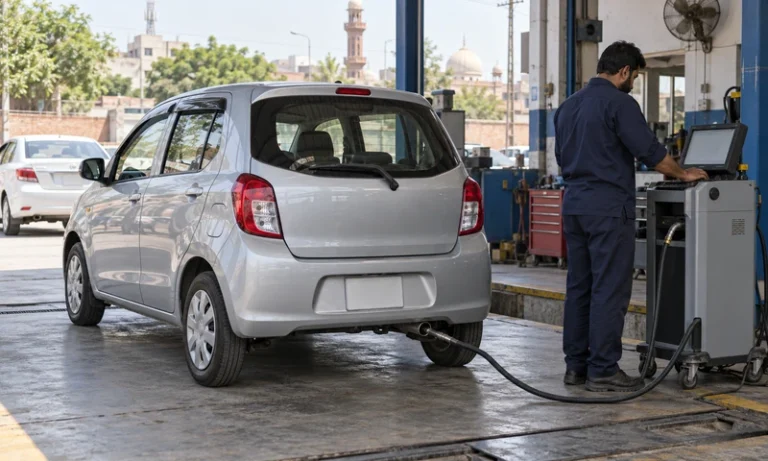
Pakistan’s government is scrambling to finalise its new Auto Policy 2026-31 as disagreements over vehicle tariffs threaten to delay its launch.
The current auto policy expires on June 30. However, officials have yet to agree on a replacement framework.
The dispute centres on whether the government should sharply cut import duties under the National Tariff Policy (NTP) or continue protecting local vehicle assemblers through higher tariffs.
The issue came under discussion at a meeting of the National Assembly Standing Committee on Finance chaired by PPP lawmaker Syed Naveed Qamar.
“The auto tariffs are being determined while duly taking into account the principles laid out in the National Tariff Policy,” Commerce Secretary Jawad Paul told lawmakers.
Government officials say full implementation of the NTP would reduce customs duties on vehicles and auto parts by 25% to 50%.
Industry experts believe lower duties could make vehicles cheaper for consumers. However, local assemblers would face tougher competition from imported vehicles.
Government Divided Over Tariff Reductions
The commerce ministry wants to cut the maximum customs duty rate to 50%.
It also proposes reducing additional customs duties and lowering regulatory duties to 20% in fiscal year 2026-27.
If approved, the maximum tariff burden would fall to 74% from the current 156%.
Reports say the 82 percentage-point gap remains the biggest obstacle to finalising the policy.
The government is also facing objections from the International Monetary Fund. Officials had proposed charging only 1% sales tax on new energy vehicles. They also suggested applying a reduced sales tax rate to hybrid vehicles.
The government is now reviewing two options. The first option would reduce tariffs to 74% in line with the NTP.
The second would lower tariffs but impose an 82% federal excise duty to maintain protection for local manufacturers.
Reportss described the second option as a majordeparture from the spirit of tariff reforms.
Cheaper Cars or Protection for Industry?
“There is so far no deviation from the approved NTP, and proposals for the second year (FY2026-27) are in line with the approved plan,” Paul told the committee.
He added that reductions would apply across most of Pakistan’s 7,590 tariff lines.
“The current maximum tariffs are 156% that will be brought down to 74%,” he said.
Under the proposed framework, customs duties on auto parts would fall from 35% to 25%.
Duties on cars and jeeps up to 800cc would decline from 50% to 30%. Tariffs on vehicles up to 1,000cc would drop from 55% to 35%. Rates on vehicles up to 1,500cc would fall from 60% to 40%.
Duties on vehicles up to 1,800cc would decrease from 75% to 45%. For vehicles above 1,800cc, tariffs would drop from 100% to 50%.
Reportss said the Prime Minister’s Office remains reluctant to reduce prices for luxury vehicles above 2,000cc.
Officials are considering federal excise duties for that segment. The commerce ministry supports gradual tariff reductions under the NTP.
The industry ministry wants stronger protection for local manufacturers.
Paul told lawmakers that IMF conditions remain less demanding than Pakistan’s own tariff reform goals. “The IMF has allowed keeping the regulatory duty rate to 80% but the government approved abolishing it in five years,” he said.
“The IMF did not set the upper cap for customs duty but the government approved reducing it to 15% by 2030.”
The commerce secretary said tariff reforms planned for fiscal year 2026-27 could reduce government revenue by Rs143.4 billion.
He also said the Engineering Development Board had recommended equal tariffs for locally manufactured, imported and used vehicles.
The outcome of the debate will shape Pakistan’s auto market for years. It could determine whether consumers get cheaper vehicles or local assemblers retain significant protection.