


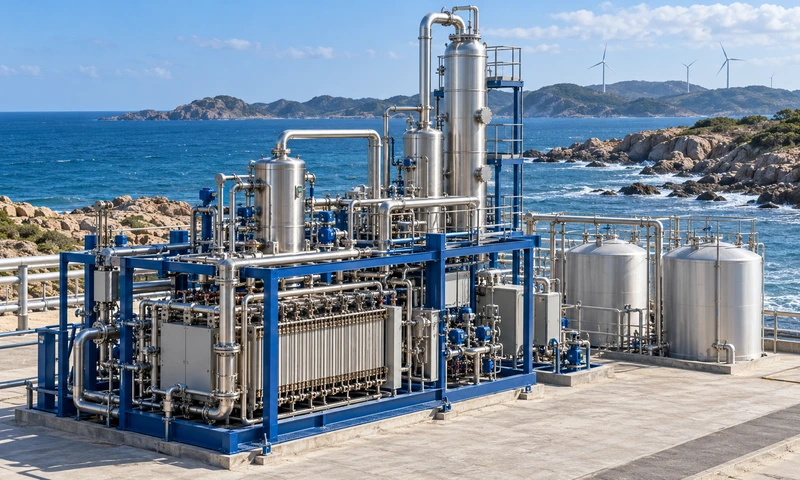
Chinese scientists have developed a seawater hydrogen plant that also produces fresh water, improving electricity utilisation by 14.4%. Its concentrated brine could support further recovery of uranium, bromine and salt.
The 250-kilowatt system captures waste heat from hydrogen production to desalinate seawater, potentially lowering green hydrogen costs.
Deng Dehui and Liu Yanting led the research at the Chinese Academy of Sciences’ Dalian Institute of Chemical Physics. Nature Energy published their study on September 15.
Turning wasted heat into fresh water
Hydrogen production from seawater generally follows two routes, each with drawbacks.
Direct electrolysis exposes equipment to chloride ions, which trigger unwanted reactions and corrode the anode. Meanwhile, calcium and magnesium deposits build up on the cathode, reducing efficiency.
The alternative removes salt through reverse osmosis or distillation before electrolysis splits purified water into hydrogen and oxygen. However, separate desalination equipment adds investment and energy costs.
The Chinese team improved this second approach by addressing an overlooked energy loss.
Read More: Pakistan’s Energy Boom: How Investors Are Flocking to Solar, Hydro, and Renewables
Commercial alkaline electrolysers typically convert about 30% of electricity into waste heat at 80–90°C. Cooling systems usually remove this heat, consuming additional energy and fresh water.
Instead, the researchers channelled it into a vacuum distillation tower. Reduced pressure allows seawater to boil at 40–50°C, after which the vapour condenses into fresh water.
The process supplies the electrolyser’s water needs and leaves additional water for external use. The remaining brine offers a feedstock for staged mineral recovery, rather than demonstrating commercial uranium extraction itself.
Plant delivers high-purity hydrogen
The larger unit produces 48 standard cubic metres of hydrogen and 31.6 kilograms of fresh water per hour. Hydrogen purity reaches 99.9999%.
SCMP reported annual production capacity of 380,000 standard cubic metres of hydrogen, equivalent to about 13.4 million standard cubic feet. It also cited 256 tonnes of fresh water annually.
The system operated for 40 days with daily starts and stops, showing no obvious deterioration, according to the supplied report.
SCMP described an earlier 25kW unit developed in 2023. However, the published study identifies a 20kW pilot that ran stably for 100 days. It produced 3.8 standard cubic metres of hydrogen and 1.2 kilograms of fresh water hourly.
The institute said an earlier pilot secured an internationally leading assessment from the China Petroleum and Chemical Industry Federation in 2023. Construction and commissioning of the 250kW plant followed in August 2024.
Costs depend on cheap renewable electricity
According to SCMP’s account, the study estimated hydrogen costs of $2.10 per kilogram using onshore wind electricity at $0.033 per kilowatt-hour.
Solar electricity at $0.049 per kilowatt-hour raised the estimate to $2.90 per kilogram. The report cited a hydrogen selling price of about $3.90, suggesting potential profitability under those assumptions.
Read More: Nara Dairy Farm Solar Project: FCEPL Adds Battery Storage
These estimates do not establish a universal market price or guarantee commercial returns.
Deng identified better catalysts, stronger waste-heat recovery and artificial intelligence to optimise operating conditions as priorities for further research.

























