China has launched naval and air patrols around the disputed Scarborough Shoal in the South China Sea, a move that underscores ongoing regional tensions over maritime sovereignty. The operation was confirmed by the Chinese People’s Liberation Army (PLA) Southern Theater Command on January 31, 2026, highlighting Beijing’s efforts to assert control in contested waters.
The shoal, known in Chinese as Huangyan Dao and in Filipino as Bajo de Masinloc, lies within the Philippines’ Exclusive Economic Zone (EEZ). Manila and Beijing both claim sovereignty over the area, and past rulings have supported the Philippines’ maritime rights under international law.
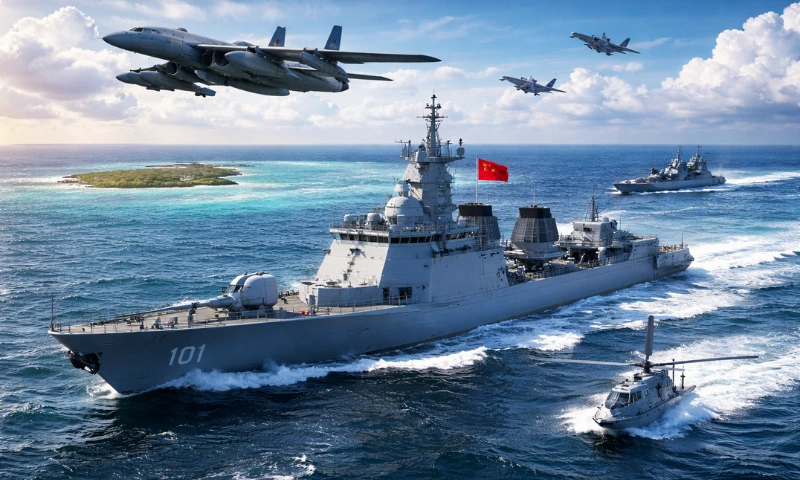
According to state media, China’s military carried out coordinated patrols involving warships and aircraft, describing the activity as “combat readiness drills.” These operations were framed as necessary to protect China’s claimed national sovereignty and to counter what Beijing calls “provocations and infringements by individual countries.”
A video released by Chinese military sources showed an H-6K bomber armed with YJ-12 anti-ship missiles and a Type 055 large destroyer participating in the patrols. This demonstration of force comes amid a broader pattern of Chinese military activity across the South China Sea, as Beijing continues to reinforce its presence in disputed maritime zones.
The Philippines has not publicly responded to the latest patrols, and its embassy in Beijing did not immediately comment on the situation.
This patrol operation follows recent joint exercises by the Philippines and the United States near the Scarborough Shoal. Manila’s armed forces announced that this week’s drills marked the 11th such exercise since November 2023, reflecting closer military cooperation in response to increasing Chinese assertiveness. The presence of U.S. ships and personnel signals Washington’s commitment to upholding freedom of navigation and supporting allies under international law.
Analysts point out that China’s patrols are part of a larger strategic approach often referred to as “gray-zone tactics.” These involve military and paramilitary activities designed to enforce territorial claims without crossing into full-scale conflict.
The South China Sea remains one of the most contested regions in the Indo-Pacific, with overlapping claims from multiple nations. In addition to Scarborough Shoal, disputes extend to the Spratly Islands and the Second Thomas Shoal, where past incidents, including collisions and aggressive maneuvers, have heightened regional anxieties.
The latest patrols will likely deepen strategic competition in the region, testing diplomatic and military responses from ASEAN members, the United States, and other Indo-Pacific partners. As Beijing continues to push its maritime agenda, the risk of miscalculation or unintended confrontation remains a persistent concern.