Germany has announced an unprecedented €1 million reward for information that leads to the arrest of suspects responsible for a deliberate arson attack on Berlin’s power grid earlier this month, authorities said. The federal government described the measure as an exceptional step to break an investigation that has so far yielded few leads.
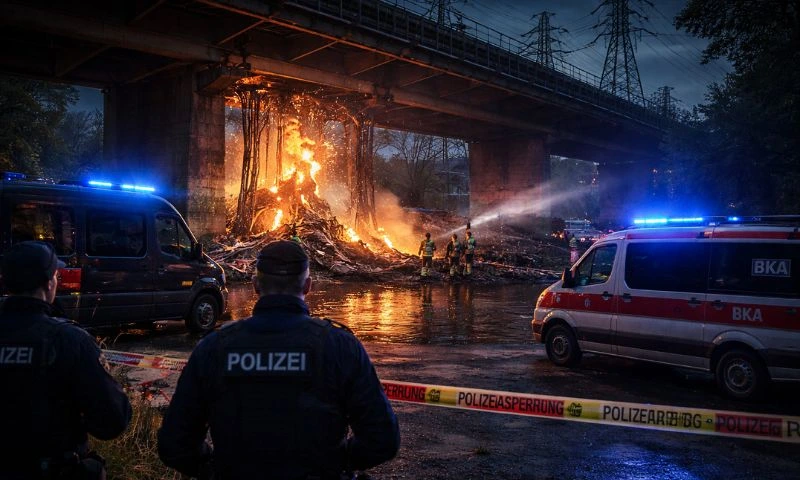
The arson attack on January 3, 2026 crippled high-voltage cables in the Lichterfelde district, triggering the longest electricity outage in the German capital since World War II. The sabotage cut power to roughly 45,000 homes and 2,200 businesses, leaving up to 100,000 residents without electricity and heating amid cold winter weather.
The attack targeted five 110 kV and ten 10 kV cables on a critical cable bridge over the Teltow Canal at a combined heat and power station. Because these lines supplied multiple substations across southwest Berlin neighborhoods such as Dahlem, Schlachtensee and Wannsee, the outage had a broad impact that took four days to fully restore.
A self-described far-left extremist collective calling itself Vulkangruppe (Volcano Group) claimed responsibility in online statements. The group has been linked to multiple acts of sabotage and arson in the Berlin region since 2011, including an attack on Tesla’s local factory in 2024. German domestic intelligence has labelled the organisation a far-left extremist movement, though its exact structure and membership remain murky.
Berlin’s Interior Senator Iris Spranger and Germany’s Interior Minister Alexander Dobrindt both stressed the severity of the incident. Spranger described the attack as an act of terrorism and said the size of the reward reflected the gravity of the crime. Meanwhile, Dobrindt vowed to “strike back” against left-wing extremism and said federal investigators were intensifying efforts to find those responsible.
“I think it is appropriate to underscore the seriousness of the situation with a reward of this magnitude,” Dobrindt told lawmakers during a parliamentary session.
The Federal Prosecutor’s Office and the Federal Criminal Police Office (BKA) have opened a terrorism investigation into the blackout. Authorities hope that the public appeal — backed by posters, leaflets and a broad publicity campaign in Berlin’s transit system — will generate tips that fast-track arrests.
The outage exposed Germany’s vulnerability to attacks on critical infrastructure, reigniting debate about protections for energy networks amid broader concerns including cyber threats and geopolitical pressures. The incident has prompted officials to review infrastructure safeguards while stepping up surveillance and protective measures.