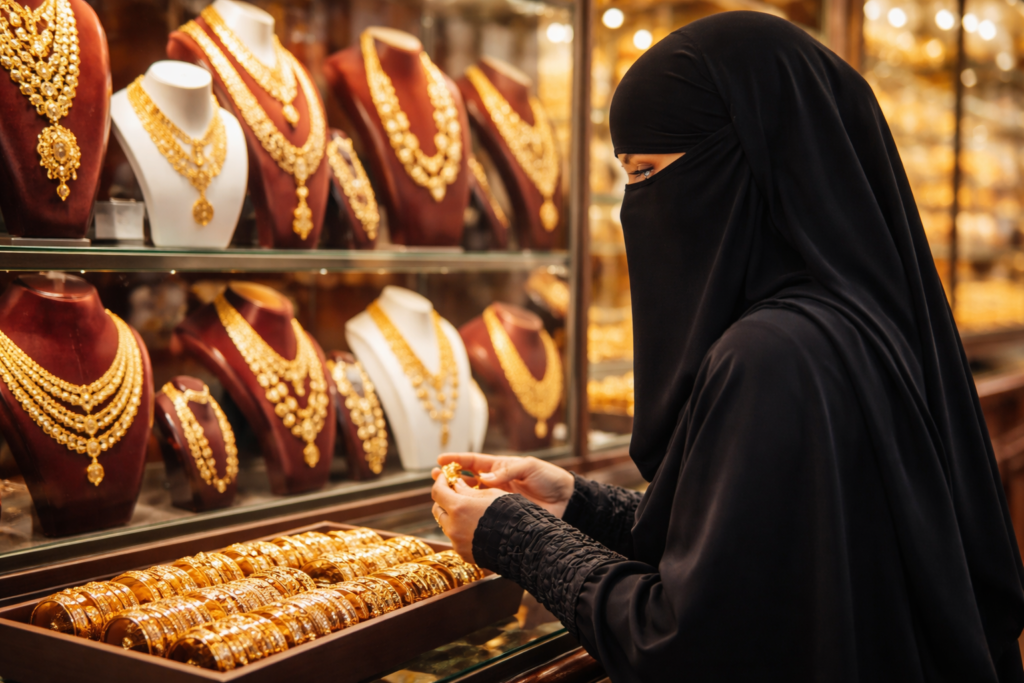
Jewellery shop owners across the Indian state of Bihar have sparked a heated debate after announcing a new security rule that bans customers from entering stores if their faces are covered. The move, adopted by the Bihar unit of the All India Jewellers and Gold Federation (AIJGF) along with local traders, applies to customers wearing hijabs, niqabs, burqas, masks, helmets, scarves or veils. Traders say the rule aims to curb rising theft and robbery, but critics describe it as discriminatory and potentially unconstitutional.
According to shopkeepers, bullion stores have become attractive targets for criminals as gold and silver prices hit record highs. With jewellery thefts on the rise, they argue that allowing customers with covered faces can make it difficult to identify individuals and track security footage during investigations. Photographer Ashok Kumar Verma, AIJGF’s Bihar president, emphasised that the ban is based on safety concerns, not prejudice against any community. He said customers could enter once they uncover their faces for identification.
The rule is set to be implemented statewide from January 8, 2026, and posters warning of the new policy have already appeared outside jewellery stores in markets such as Patna and Muzaffarpur. Traders say the decision follows consultations with local police, who reportedly raised no objections. Verma also clarified that no shop staff will forcibly remove anyone’s hijab or burqa, and that requests to uncover faces will be made politely.
Opposition and Political Debate
The decision has not gone unchallenged. Rashtriya Janata Dal (RJD) — Bihar’s main opposition party — condemned the rule, calling it unconstitutional and harmful to India’s secular and democratic values. RJD spokesperson Ejaz Ahmed claimed it could undermine citizens’ fundamental right to religious freedom and fuel social division, especially by appearing to target Muslim women who wear hijabs or niqabs as part of their faith. Ahmed urged shop owners to withdraw the directive immediately and explore alternative security measures.
The issue has now become a broader political flashpoint in the state. Opposition leaders have questioned whether such measures unfairly single out religious attire and could set a dangerous precedent for other public spaces and businesses. Meanwhile, some proponents of the ban stress that the rule applies to everyone, including men wearing helmets or scarves, and is strictly a crime-prevention strategy rather than a cultural judgment.
Regional Context and Reactions
The Bihar decision mirrors similar precautions taken in parts of neighboring states, where traders have discouraged customers from covering their faces in high-value markets to prevent robberies. However, opponents argue that blanket rules risk alienating segments of the population and may drive away customers who feel singled out or uncomfortable.
Some community groups have also rallied in support of people who may be affected. Reports indicate that organisations such as Jamaat‑e‑Islami Hind have urged customers to boycott shops enforcing such bans, saying religious attire should be respected and that alternative security measures should be adopted.
Searching for Balance
As the policy takes effect, authorities and business leaders in Bihar face mounting pressure to strike a balance between legitimate security concerns and citizens’ rights. The coming weeks are likely to shape how similar rules are interpreted and applied in other parts of India.