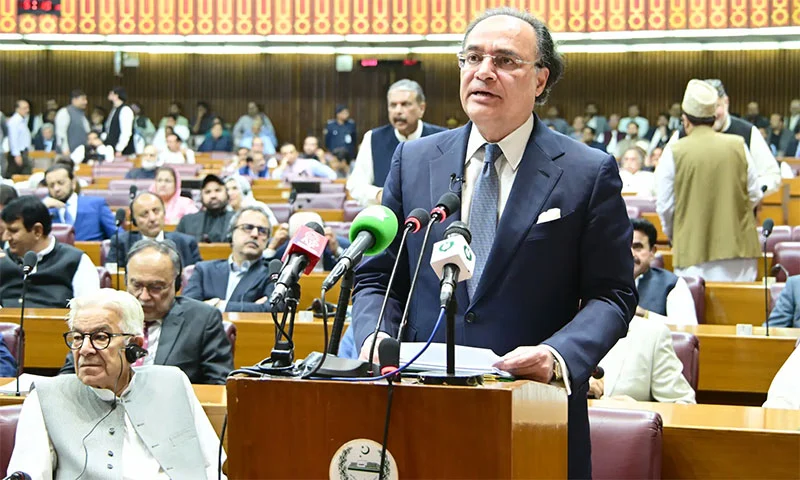
Finance Minister Muhammad Aurangzeb on Friday unveiled a Rs18.8 trillion federal budget for fiscal year 2026-27, outlining tax relief for salaried individuals, increased defence spending, higher development allocations and a roadmap aimed at sustaining economic recovery.
The budget was presented in the National Assembly amid noisy protests by opposition lawmakers. The session began nearly two hours behind schedule and witnessed slogan chanting, desk thumping and brief confrontations between treasury and opposition members.
Presenting his third budget, Aurangzeb said Pakistan’s international standing had improved significantly over the past year.
“This budget is being presented at a time when Pakistan has achieved the status in the eyes of its people and the world as a country whose voice is listened to, and whose friendship is desired.”
He added that Pakistan’s military and diplomatic achievements had strengthened its global position.
“Today, the world acknowledges Pakistan’s defensive strength,” he said, while also highlighting Pakistan’s role in efforts aimed at securing peace between Iran and the United States.
Key Economic Targets for FY2026-27
The government has projected economic growth of 4 percent for the next fiscal year, while average inflation is expected to remain at 8.2 percent.
The fiscal deficit is projected at 3.6 percent of GDP, while the primary surplus is targeted at 2 percent.
Tax revenue has been estimated at Rs15.264 trillion, representing an increase of 17.6 percent compared to the outgoing fiscal year’s collection target.
The finance minister said the tax-to-GDP ratio had increased from 8.5 percent to 10.3 percent during the last three years.
He also highlighted improvements in fiscal stability.
“Our fiscal deficit in June 2023 was 7.8% of GDP, which by the end of the current financial year will come down to 4%.”
Defence and Debt Servicing Receive Largest Allocations
The largest share of the budget has been allocated for debt servicing.
Aurangzeb said Rs8.045 trillion has been earmarked for markup payments, accounting for the biggest component of federal expenditure.
Defence spending has been allocated Rs3 trillion.
The finance minister described defence as the government’s highest priority, citing regional security challenges and Pakistan’s strategic interests.
Meanwhile, civil administration expenditures have been budgeted at Rs1.071 trillion.
The government has also allocated Rs1.169 trillion for pension payments and Rs1.091 trillion for subsidies, mainly in the power sector.
Rs1 Trillion Development Programme Approved
The federal Public Sector Development Programme has been allocated Rs1 trillion for FY2026-27.
After including investments by state-owned enterprises and public-private partnership projects, the total development envelope rises to Rs1.451 trillion.
Aurangzeb said provincial development programmes would receive Rs2.224 trillion, while Rs451 billion has been allocated for investments through state-owned enterprises.
“This allocation reflects the new distribution of responsibilities following the 18th Constitutional Amendment.”
He said more than 60 percent of federal development spending would focus on transport, communications, water resources and energy projects.
Affordable Housing and Urban Development
The government has allocated Rs54.6 billion for sustainable urban development and housing initiatives.
According to the finance minister, the allocation will support the construction of 150,000 affordable and climate-resilient housing units across Pakistan.
The programme also includes digital master plans for 10 major cities and improvements in urban water supply and sanitation infrastructure.
Tax Relief for Salaried Class
The government proposed income tax reductions for salaried individuals across four income slabs.
For annual incomes between Rs2.2 million and Rs3.2 million, the tax rate would decline from 23 percent to 20 percent.
For those earning between Rs3.2 million and Rs4.1 million, the rate would fall from 30 percent to 25 percent.
Taxpayers earning between Rs4.1 million and Rs5.6 million would see their rate reduced from 35 percent to 29 percent.
Meanwhile, individuals earning between Rs5.6 million and Rs7 million would pay 32 percent instead of 35 percent.
The government also proposed removing taxes on sanitary pads and contraceptives.
Government employees will receive a 7 percent salary increase, while pensions will rise by 7 percent. The minimum wage has also been proposed to increase by 10 percent.
Super Tax Reduced for Businesses
Aurangzeb announced the abolition of the super tax for businesses earning between Rs150 million and Rs500 million annually.
For companies earning more than Rs500 million, the super tax rate would be reduced from 10 percent to 8 percent.
The government said the measure aims to improve the business environment and encourage investment.
Health, Education and Technology Spending Increased
The federal government has allocated Rs25.1 billion for health projects.
These include expansion of tertiary healthcare facilities, cancer treatment centres, emergency care services and disease surveillance systems.
For higher education, Rs46 billion has been allocated, up from Rs34.9 billion last year.
The allocation includes scholarships, research initiatives, digital learning programmes and AI-based education systems.
Additionally, Rs3.6 billion has been earmarked for science and technology projects.
Energy Reforms and LNG Savings
The finance minister said Pakistan’s energy sector was undergoing its deepest reform phase.
He said the government saved more than Rs143 billion in electricity subsidies during FY2025-26.
According to Aurangzeb, Pakistan also achieved net-zero accumulation of circular debt in the power sector.
He added that renegotiated LNG agreements with Qatar and Italy would reduce 35 LNG cargoes in 2026, generating savings of approximately $1.2 billion in foreign exchange.
Economy Shows Signs of Recovery
Aurangzeb said Pakistan’s economy grew by 3.7 percent during the outgoing fiscal year.
Large-scale manufacturing expanded by 6.1 percent, while the services sector grew by 4.1 percent.
The country’s economic size reached $452 billion, while per capita income increased to $1,901 from $1,751 a year earlier.
Foreign exchange reserves rose to $17 billion compared to $4 billion three years ago.
The finance minister also said remittances are expected to exceed a record $41 billion by the end of FY2025-26.
Corporate Sector, Stock Market and Privatisation
The finance minister said corporate profits increased by 22 percent during January-March 2026 compared to the same period last year.
The Pakistan Stock Exchange also witnessed a record increase in investor participation.
According to Aurangzeb, 11 initial public offerings were launched this year, the highest number in two decades.
More than 39,000 new companies were registered with the Securities and Exchange Commission of Pakistan.
He also highlighted the privatisation of Pakistan International Airlines for Rs185 billion and said the government would continue privatising selected state-owned entities over the next five years.
Debt Management Strategy
Aurangzeb said the government reduced its debt burden by Rs4.9 trillion over the past two years through early repayments and cheaper borrowing.
The average maturity of domestic debt increased from 2.8 years in 2024 to 3.8 years in May 2026.
He said the government would continue introducing measures aimed at reducing borrowing costs and improving debt sustainability.