The United States and Iran exchanged fresh air and missile strikes on Thursday for a second consecutive day, deepening tensions and casting fresh doubt on a fragile ceasefire that has struggled to hold since April.
The latest escalation followed the downing of a US Apache helicopter near the Strait of Hormuz earlier this week, an incident that triggered a new round of military action across the Gulf region.
The US military said it carried out strikes targeting Iranian military surveillance systems, communication networks and air defence sites. According to US Central Command, the operation aimed to counter what it described as Tehran’s “unwarranted and continued aggression.”
President Donald Trump signalled that military pressure would continue unless Iran accepted a peace agreement with Washington.
Fox News correspondent Trey Yingst reported on X that Trump said the strikes would end shortly but warned he would resume heavy bombing if Iranian leaders did not immediately sign a deal with the United States.
The renewed fighting marks the most serious challenge yet to the ceasefire reached in April. The truce followed weeks of intense warfare that began in late February after large-scale US and Israeli air strikes on Iran.
Oil markets reacted swiftly. Crude prices jumped nearly $3 after Trump’s latest warning and extended gains during early Asian trading, reflecting concerns over disruptions to global energy supplies.
Iran Launches Counterattacks Across Gulf
Iran’s Islamic Revolutionary Guard Corps (IRGC) said it responded by targeting 18 US military positions, including facilities in Kuwait and Bahrain and the headquarters of the US Navy’s Fifth Fleet.
The IRGC also announced a second consecutive night of missile attacks on the al-Azraq air base in Jordan, saying it launched 12 ballistic missiles at the installation.
Kuwait’s military reported that its air defences were engaging hostile aerial targets, while Bahraini authorities said they intercepted and destroyed incoming Iranian threats.
Iran’s top joint military command also warned that any vessel attempting to pass through the Strait of Hormuz could come under fire. Iranian state media claimed forces had fired on two US ships in the strategic waterway.
Read More: Iran Conflict Triggers $100 Billion Shock for Global Airlines
US Central Command rejected those claims and insisted commercial vessels continued to transit the strait despite Iranian threats.
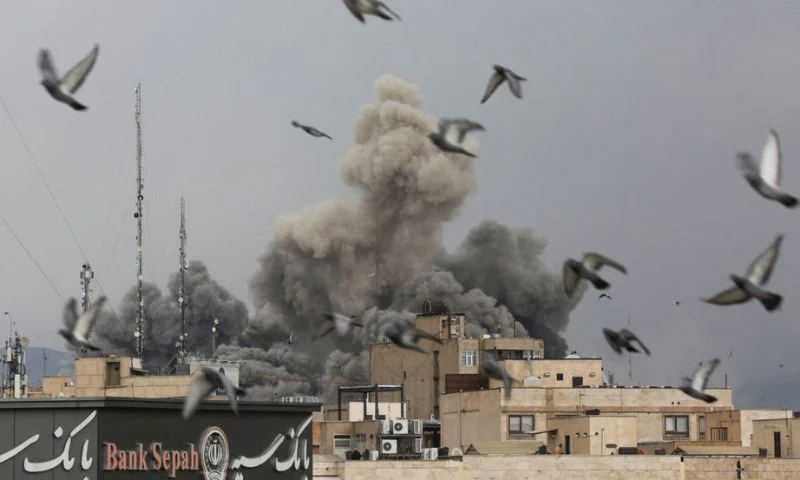
Iranian media reported explosions in several cities, including Sirik, Kargan, Bandar Abbas, Minab, Karaj and Varamin.
US Defence Secretary Pete Hegseth defended the military action during a visit to Central Command headquarters in Florida.
The strikes would “advance our military interests and also enhance our diplomatic position,” he said.
“We will strike them hard tonight, and hopefully Iran makes a good decision,” Hegseth added. “If we need to negotiate with bombs, we’ll negotiate with bombs.”
Hormuz Dispute, Lebanon Fighting Complicate Peace Efforts
The Strait of Hormuz remains at the centre of the crisis. Iran says it has effectively closed the vital shipping route, while US officials deny the claim and maintain that maritime traffic continues.
The waterway handles roughly one-fifth of the world’s crude oil and liquefied natural gas shipments, making it one of the most important energy corridors on the planet.
Iran accused the United States of striking reservoirs that supplied drinking water to 10 villages.
“This is not collateral damage – it is a calculated war crime and a flagrant violation of human rights,” Iranian Foreign Ministry spokesperson Esmaeil Baghei said.
At the same time, fighting continued in Lebanon. Lebanese security sources said Israeli air strikes in southern Lebanon killed at least 13 people on Wednesday. Hezbollah later claimed new attacks against Israeli forces, while Israel reported launches near areas where its troops were operating.
Diplomatic efforts remain stalled despite repeated claims from Trump that a deal is within reach. Tehran continues to demand an end to Israeli attacks in Lebanon, the lifting of sanctions, the release of frozen Iranian assets and recognition of its control over the Strait of Hormuz.
Washington insists any agreement must guarantee freedom of navigation through Hormuz and prevent Iran from developing a nuclear weapon, an ambition Tehran continues to deny.