US President Donald Trump said on Thursday that the United States and Iran could sign a peace agreement within days, raising hopes for an end to a conflict that has rattled global energy markets and destabilised the Middle East for more than three months.
Speaking at the White House, Trump claimed negotiations had reached a decisive stage and suggested a formal signing could take place in Europe as early as this weekend.
“We just made a great settlement of the war with Iran,” Trump told reporters.
“The strait will officially open as soon as we sign, which could be soon, very soon, maybe over the weekend in Europe,” he added.
Trump also said Vice President JD Vance could sign the agreement on behalf of the United States. When asked whether Iran’s Supreme Leader Ayatollah Mojtaba Khamenei had approved the arrangement, Trump replied: “I understand the answer is yes.”
His remarks came shortly after he cancelled planned military strikes against Iran.
In a statement posted on Truth Social, Trump said: “Based on the fact that discussions with the Islamic Republic of Iran have been brought to the highest level of Iranian leadership and approved, I have, as President of the United States of America, cancelled the scheduled strikes and bombings against Iran this evening.”
However, Tehran quickly signalled caution. Iran’s semi-official Fars News Agency reported that Iranian leaders were likely to approve the agreement, while the country’s foreign ministry said reports of a finalised deal remained speculative.
Conflict Escalates Despite Diplomatic Signals
The diplomatic developments followed another night of military escalation.
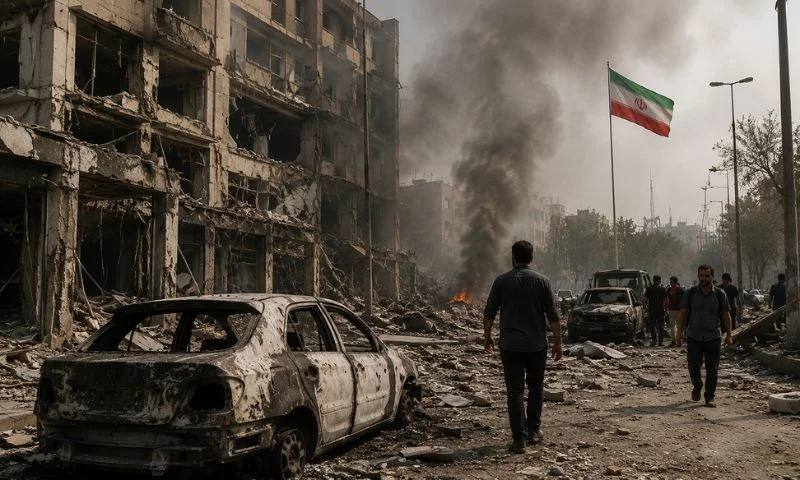
The US military said it struck Iranian military surveillance systems, communication networks and air defence positions across the country.
According to US Central Command, American forces used precision munitions against targets that posed threats to US personnel and commercial shipping.
Iran responded with missile attacks on American military assets in Bahrain, Jordan and Kuwait.
The Islamic Revolutionary Guard Corps (IRGC) said it targeted 18 US military sites and struck key facilities, including air bases in Bahrain and Jordan.
Iranian media reported explosions in Bandar Abbas, Kargan and Minab following the American attacks.
Iran’s foreign ministry condemned the strikes and argued they had rendered the nearly two-month ceasefire “practically meaningless.”
Parliament Speaker Bagher Ghalibaf also issued a warning to Washington.
“Wrong strategies and impulsive decisions will reset the entire board for the worse, explode energy infrastructure and markets and create an endless quagmire that you will be stuck in for years,” he said.
“You will see a different Iran.”
Hormuz Closure Raises Global Concerns
The crisis deepened after Iranian authorities confirmed a complete closure of the Strait of Hormuz until further notice.
The strategic waterway handles roughly one-fifth of global oil shipments and remains one of the world’s most important energy routes.
Iran’s Khatam al-Anbiya Central Headquarters warned that threats against Iranian energy infrastructure could trigger broader disruptions.
“Either oil and gas exports are for everyone, or they will be available for no one,” the command said.
Despite the tensions, oil prices fell after Trump announced the suspension of planned strikes. Brent crude dropped 2.7% to $90.60 per barrel, while US West Texas Intermediate crude fell 2.6% to $87.71.
Saudi Arabia called for renewed diplomacy and backed mediation efforts led by Pakistan and Qatar. Pakistan also urged all sides to pursue dialogue and a negotiated settlement.
The United Nations, China, Russia, Turkiye and the European Union issued similar calls for restraint as diplomats raced to prevent a wider regional conflict.
Whether the proposed agreement materialises remains uncertain. However, the coming days could prove critical for both regional stability and global energy markets.