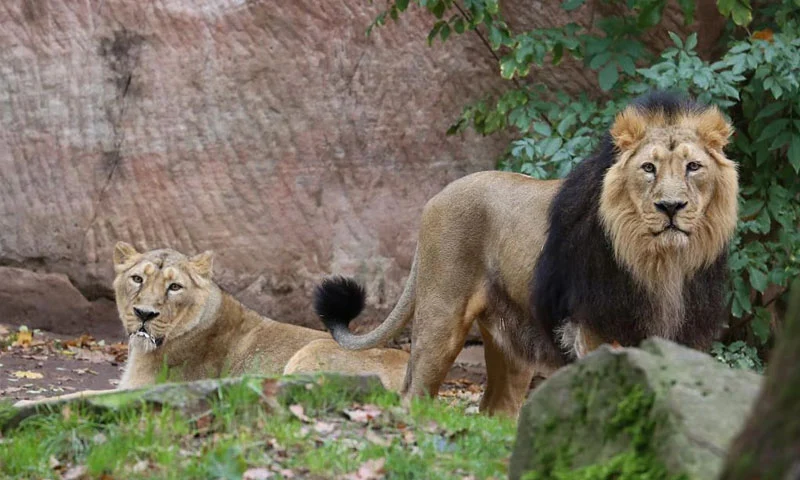
India’s Asiatic lion population has surged by more than 70% over the past decade, marking a major conservation success for one of the world’s rarest big cats.
The population reached an estimated 891 lions in 2025, up from 523 in 2015. The latest figure also represents a 32% increase from 674 lions counted in 2020.
The findings come from the 16th Asiatic Lion Population Estimation, carried out across Gujarat in May 2025.
Union Environment Minister Bhupender Yadav highlighted the figures on World Lion Day on August 10, 2026.
“India’s success in conserving the Asiatic Lion is a proud testament to our unwavering commitment to wildlife and biodiversity,” Yadav said.
The recovery is particularly significant because India holds the world’s only remaining wild population of Asiatic lions.
Lion Range Expands Far Beyond Gir
The lions have not only increased in number. They have also spread across a much larger area of western India.
Their range covered around 30,000 square kilometres in 2020. It now extends across nearly 35,000 square kilometres and 11 districts of Gujarat.
That represents an increase of about 16.7% in just five years.
In 1990, the animals occupied only about 6,600 square kilometres. Their current range is more than five times larger.
Government data shows that lions have moved into new forest areas, river corridors and revenue wastelands.
India has also strengthened veterinary services to tackle disease risks and reduce conflict between people and lions. Officials use satellite telemetry and real-time tracking to study lion movements.
The recovery follows decades of conservation work.
Asiatic lions once ranged much more widely across Eurasia. Today, their only wild population survives in western India.
Their numbers had fallen dramatically because of hunting and habitat loss. Only around 40 to 60 lions remained in and around Gir during the early 20th century, according to historical conservation accounts.
Better Prey Base Helps Lions Recover
Conservation authorities credit several factors for the population increase.
India gave Asiatic lions strict legal protection and expanded conservation beyond the traditional Gir protected areas.
Officials also worked to rebuild populations of wild prey.
Spotted deer, sambar, nilgai and wild pigs now account for around 74% of the lions’ diet. In 1974, wild prey made up only about 26%.
This stronger prey base has helped reduce the lions’ dependence on livestock.
Local communities have also played an important role.
Authorities have secured more than 55,000 open wells to prevent lions from falling into them. Compensation schemes for livestock losses have also helped reduce conflict with residents.
Project Lion, announced in 2020, now supports a wider landscape-based conservation strategy.
The programme focuses on habitat restoration, disease monitoring, veterinary care, scientific tracking and community participation.
Lions Return to Barda After More Than a Century
One of the clearest signs of the population’s recovery has come from Barda Wildlife Sanctuary.
Asiatic lions disappeared from the area during the 19th century.
They naturally returned to Barda in 2023. By 2025, the sanctuary supported 17 lions, including six adults and 11 cubs.
The Indian government describes Barda as an emerging second home for the species.
The sanctuary covers more than 192 square kilometres across Porbandar and Devbhumi Dwarka districts.
India has also approved plans for a safari park in the wider Barda area alongside additional wildlife conservation projects.
Despite the strong recovery, conservation challenges remain.
The Asiatic lion still exists as a single wild population concentrated within one region. That leaves the species vulnerable to disease outbreaks, natural disasters and other large-scale threats.
However, the rise from 523 lions in 2015 to 891 in 2025 shows how dramatically the population has recovered.
With the number now approaching 1,000, India’s Asiatic lion conservation programme has become one of the country’s most prominent wildlife recovery efforts.