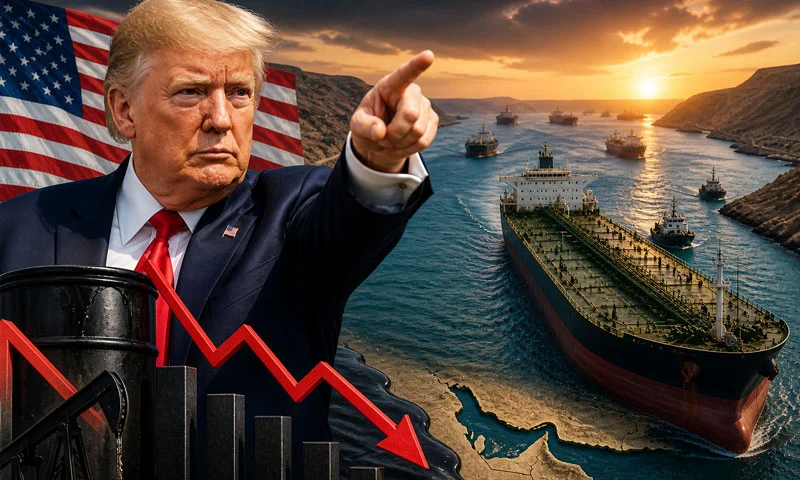
Oil prices edged lower on Monday after Donald Trump said Washington would begin efforts to free ships stranded in the Strait of Hormuz, although the absence of a US-Iran peace deal kept crude trading above $100 a barrel.
Brent crude futures fell 64 cents, or 0.59%, to $107.53 a barrel by 2308 GMT, extending a $2.23 drop on Friday. U.S. West Texas Intermediate crude stood at $101.10 a barrel, down 84 cents, or 0.82%, after losing $3.13 in the previous session.
Read More: Crude Rally Sparks Fears of $140 Oil Amid Rising Tensions
Markets reacted to Trump’s announcement of a maritime initiative aimed at easing congestion in the Strait of Hormuz, a key route for roughly a fifth of global oil supply. The waterway has faced severe disruption due to ongoing tensions involving Iran, raising fears of prolonged supply constraints.
“For the good of Iran, the Middle East, and the United States, we have told these Countries that we will guide their Ships safely out of these restricted Waterways, so that they can freely and ably get on with their business,” Trump wrote on his Truth Social platform.
He expanded on the plan, calling it “Project Freedom,” and said it would begin Monday morning Middle East time. Trump added that countries not involved in the conflict had requested U.S. assistance to free their vessels.
“Countries from all over the World… have asked the United States if we could help free up their Ships, which are locked up in the Strait of Hormuz,” he said, describing them as “neutral and innocent bystanders.”
He warned that any interference with the operation “will, unfortunately, have to be dealt with forcefully,” while framing the effort as a humanitarian step. “Many of these Ships are running low on food, and everything else necessary for largescale crews to stay on board in a healthy and sanitary manner,” he said.
Stalled talks keep oil above $100
Despite the announcement, oil prices remained supported as diplomatic progress between Washington and Tehran stalled. Negotiations continued over the weekend, with both sides assessing responses but holding firm on key demands.
Read More: US President Donald Trump Threatens Iran’s Oil and Power Infrastructure if Talks Fail
“Peace talks have been stalled as both sides refuse to move on their respective red lines,” analysts at ANZ said.
Trump has pushed for a nuclear agreement with Iran. Tehran has suggested postponing nuclear discussions until the conflict ends and both sides lift shipping blockades in the Gulf.
The lack of a breakthrough has kept traffic in the Strait limited, sustaining concerns about supply disruptions. Traders continue to price in geopolitical risk as long as tensions threaten one of the world’s most critical oil corridors.
OPEC+ output increase seen as limited support
Separately, OPEC+ said on Sunday it would raise output targets by 188,000 barrels per day in June for seven member countries, marking a third straight monthly increase.
Read More: Think Saudi Arabia Has the Most Oil? Here’s the Real Top 10 List
The increase matches May levels but excludes the share of the United Arab Emirates, which left OPEC on May 1. Analysts expect the additional supply to have limited impact while conflict-linked disruptions persist in the Strait of Hormuz.
Energy markets remain sensitive to developments in both diplomacy and shipping security. Until flows normalize or a deal emerges, prices are likely to stay volatile and elevated.