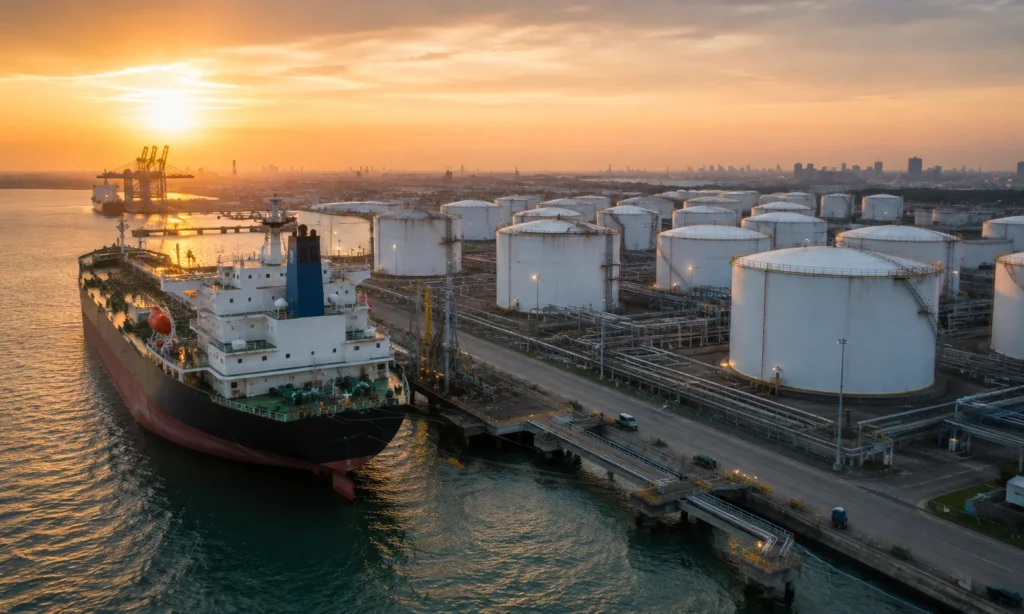
Pakistan plans to open its petroleum storage sector to international suppliers under a new customs-bonded framework. The government hopes the move will strengthen energy security and turn the country into a regional fuel storage and trading hub.
The Petroleum Division has sent the 168-page Policy Guideline on Import on Foreign Suppliers’ Account through Customs Bonded Storage Facilities-2026 to the Economic Coordination Committee for approval.
The framework covers crude oil of all grades, motor spirit, high-speed diesel, jet fuel, fuel oil, LPG and LNG. Proposed storage locations include Port Qasim, KPT/Kemari, Hub, Gwadar, Mahmood Kot and Machike Sheikhupura. Regulatory and safety approvals would still apply.
Foreign suppliers could store, sell or re-export fuel
Under the proposal, international suppliers could bring petroleum into Pakistan and place it in bonded storage without immediately paying domestic duties and taxes. They could later sell the fuel locally or re-export it when market conditions become more attractive.
Suppliers could operate through a registered liaison office, local branch or incorporated company acting as consignee. That entity could build dedicated storage or use licensed public and private facilities.
Read More: Pakistan Restricts Gas to Factories as Middle East War Disrupts Energy Flow
The policy targets suppliers from major producing countries, including Saudi Arabia and Kuwait. Pakistan has also discussed storage cooperation with Saudi Arabia, Kuwait and Qatar as it searches for stronger supply arrangements.
Foreign suppliers would retain the right to re-export their stocks, except for sanctioned goods or items on the applicable Negative List.
Pipeline access could move stocks inland
The framework would allow bonded petroleum to travel through Pakistan’s pipeline network without triggering tax merely because the fuel changes location.
Suppliers could move stocks from ports to approved inland storage facilities, including Mahmood Kot and Machike Sheikhupura. Customs-supervised movements could also take place between bonded terminals, refineries, pipelines, ports and export facilities.
The proposal aims to keep the system tax-neutral while products remain bonded. It says taxes, duties, levies, charges and cesses would apply only when fuel enters the domestic market.
This could let suppliers position fuel closer to major consumption centres while preserving their export option.
Energy security drives new policy push
The 2026 proposal follows an earlier bonded-storage policy introduced in July 2023. The Petroleum Division still lists that framework among its official policy documents.
However, no foreign supplier established bonded storage under the earlier policy, according to a June briefing reported by The Express Tribune. The government then began revising the framework after recent regional disruptions exposed weaknesses in Pakistan’s energy supply system.
Reuters reported in May that Pakistan lacks strategic petroleum reserves and relies on the Strait of Hormuz for up to 90% of its oil and LNG imports.
“Pakistan’s oil security requires both emergency reserves and stronger local supply capacity,” the Energy Ministry said.
Read More: Turkiye to Begin Offshore Drilling in Pakistan for Oil and Gas
Petroleum Minister Ali Pervaiz Malik also acknowledged the challenge, saying building reserves was “easier said than done” for a country facing tight fiscal constraints.
If approved, the new framework could increase petroleum stocks physically available inside Pakistan. It could also reduce reliance on the timely arrival of individual cargoes during international supply disruptions.