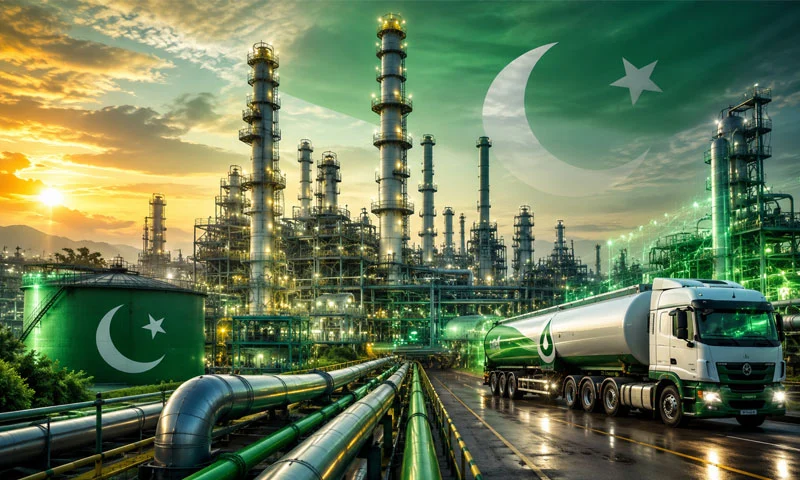
Pakistan’s five major oil refineries have agreed to move ahead with long-delayed modernisation agreements that could unlock more than $6 billion in investment.
The upgrades aim to modernise ageing facilities and increase domestic production of cleaner Euro 5-compliant fuels. They could also reduce Pakistan’s dependence on imported petrol and diesel.
Federal Minister for Petroleum Ali Pervaiz Malik held separate meetings with the management of PARCO, Pakistan Refinery Limited, National Refinery Limited, Cnergyico and Attock Refinery Limited.
The meetings reviewed the Brownfield Refinery Upgradation Policy, refinery performance and measures to strengthen Pakistan’s energy security.
Read More: Pakistan Plans Major Oil Storage Reform to Reduce Supply Risks
All five refineries reaffirmed their readiness to sign the required agreements. Industry representatives said the agreements could be signed as early as next week.
The Petroleum Division had previously described the broader refinery upgrade programme as worth more than $6 billion. It said the projects would improve fuel standards and reduce dependence on imported petroleum products.
Refineries Move Closer to Euro 5 Fuel Production
Malik said modernisation was essential for the long-term sustainability of Pakistan’s refining sector.
The planned investments will allow local refineries to produce Euro 5-compliant petrol and diesel. That could reduce the need to import higher-quality finished fuels.
It may also lower exposure to international freight costs and external supply disruptions.
The Petroleum Division has previously said cleaner domestic fuels could improve engine performance and reduce emissions.
In an earlier statement on the upgrade programme, Malik said:
“The refinery upgrades will not only enhance production efficiency but also align with our goal of transitioning toward cleaner and more sustainable energy sources.”
The minister stressed during the latest meetings that timely signing of the agreements was critical.
He assured the industry that the government would help resolve implementation problems and support companies seeking financing.
Recent project-level estimates show the scale of the planned work.
Pakistan Refinery Limited is considering an investment of around $1.8 billion to $2 billion. Its project aims to double crude-processing capacity from 50,000 barrels per day to 100,000 barrels.
Read More: Turkiye to Begin Offshore Drilling in Pakistan for Oil and Gas
PRL also plans to cut furnace oil production and shift towards higher-value products.
Attock Refinery Limited is preparing an upgrade estimated at about $600 million. The project would help it meet Euro 5 standards and increase petrol production by about 25%.
Cnergyico is planning investment of around $1.2 billion. Its programme includes cleaner fuel production, capacity expansion and a new Single Point Mooring facility.
The company also plans to increase refining capacity from about 156,000 barrels per day to nearly 200,000 barrels.
PARCO has been working on a roughly $600 million green-fuel project. National Refinery Limited is considering an upgrade that could cost between $300 million and $800 million.
The final investment level will depend on project scope, financing and phasing.
Hormuz Crisis Puts Energy Security in Focus
The refinery push has gained fresh urgency after recent disruptions around the Strait of Hormuz.
Pakistan relies heavily on imported petroleum and other energy supplies. Disruption to major shipping routes can therefore expose the country to shortages and price shocks.
Malik praised PARCO for maintaining operations during the recent Strait of Hormuz crisis.
He said Pakistan managed the disruption without allowing the petroleum supply system to run dry.
The minister stressed the need for resilient supply chains and stronger domestic refining capacity.
The government has separately launched a feasibility study for strategic petroleum reserves. International consultancy Wood Mackenzie has been selected for the study after a competitive tender process.
Malik said the Hormuz crisis had highlighted the need for greater protection against external supply shocks.
Read More: Moody’s Lifts Pakistan’s Sovereign Credit Rating to B3 from Caa1
The government wants the proposed reserves to complement refinery upgrades and other energy-security measures.
During his meeting with PARCO, officials also briefed Malik on plans for a proposed Oil City in Hub.
The project is envisaged as an energy terminal and storage complex. It aims to strengthen supply security, improve trade connectivity and support economic activity.
Agreements Could End Years of Delay
The refinery agreements have faced repeated delays since Pakistan introduced its Brownfield Refinery Upgradation Policy.
The policy aims to encourage existing refineries to invest in cleaner fuel production and reduce output of high-sulphur furnace oil.
Some refineries had signalled readiness to sign agreements as far back as 2024. However, taxation issues, policy changes and disagreements over implementation delayed the programme.
The government and industry have spent recent months trying to resolve those disputes.
ARL told the petroleum minister that it had completed its preparations and remained ready to proceed.
Cnergyico and NRL also told Malik that they were prepared to sign.
The ARL management stressed that modernisation was necessary to keep Pakistani refineries aligned with changing global fuel standards.
Malik reiterated that the government would continue working with the industry to move the programme forward.
Read More: Pakistan’s Economy Gets Fresh Boost as Exports Rise 13% in July
The upgrades could significantly change Pakistan’s refining structure if companies reach financial close and complete the projects.
They would allow refineries to produce more petrol and diesel locally while reducing lower-value furnace oil output.
For Pakistan, the government sees the programme as more than an industrial investment.
It is also part of a wider effort to cut import dependence, improve fuel quality and make the country less vulnerable to disruptions in global energy markets.