


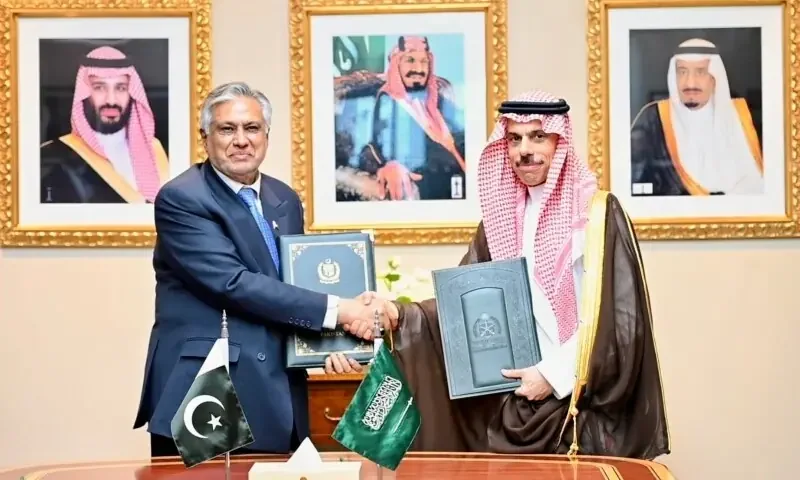
Pakistan and Saudi Arabia have outlined plans to expand agricultural trade, strengthen defence cooperation and ease travel through a series of agreements and initiatives.
The developments include a goal to raise Pakistani agricultural and food exports to the kingdom to $3 billion. They also cover a joint defence agreement involving Turkiye and a multiple-entry Umrah visa.
Frequent high-level diplomatic exchanges underpin the relationship, with recent contacts covering security, trade and travel. The measures span both government cooperation and opportunities for Pakistani exporters and travellers.
Agricultural exports targeted at $3 billion
Pakistan and Saudi Arabia agreed in August to boost Pakistani agricultural and food exports to the Gulf state up to $3 billion.
The understanding came during a visit by a Saudi delegation led by Minister of Environment, Water and Agriculture Engineer Abdulrahman Al-Fadley.
The export goal places agriculture and food supplies among the priorities for bilateral economic cooperation. For Pakistan, the proposed expansion would mean greater access to the Saudi market for these products.
Read More: Trump Backs Major Saudi Fighter Upgrade With $24.3bn F-35 Plan
However, the supplied account does not specify a deadline for reaching the $3 billion figure. It also provides no breakdown of the products covered or their current export value.
The figure represents an agreed expansion goal, rather than exports already achieved. Further details would establish how the two countries intend to translate that goal into commercial orders.
Defence agreement brings Turkiye into cooperation
On August 7, Pakistan and Saudi Arabia signed a joint defence agreement alongside Turkiye.
The three countries pledged to strengthen collective security, deepen defence cooperation and promote peace and stability in the region and beyond.
Deputy Prime Minister/Foreign Minister Senator Mohammad Ishaq Dar @MIshaqDar50 met with His Highness Prince Faisal bin Farhan Al Saud @FaisalBinFarhan, Foreign Minister of Saudi Arabia, on the sidelines of the 81st Session of the UN General Assembly in New York today.
The two… pic.twitter.com/QyrhzdriyG
— Ministry of Foreign Affairs – Pakistan (@ForeignOfficePk) September 22, 2026
The agreement adds a three-country security framework to Pakistan and Saudi Arabia’s existing bilateral relationship. Its stated objectives extend beyond defence cooperation to wider regional peace and stability.
The supplied material does not outline operational arrangements or specific military commitments under the agreement.
High-level diplomatic exchanges remain a central feature of Pakistan-Saudi relations. The August developments show how those contacts encompass economic cooperation alongside security matters.
Umrah and tourist visa measures widen access
Saudi Arabia also launched a multiple-entry Umrah visa in July, with one-year validity from the date of issuance.
Under the arrangements described in the supplied report, pilgrims can enter the kingdom several times during that period. Their cumulative stay can total up to 90 days each year.
Pleased to announce that on the sidelines of #UNGA2026,
I signed today with my brother, His Highness Prince Faisal bin Farhan @FaisalbinFarhan, the “Agreement between Islamic Republic of Pakistan and Kingdom of Saudi Arabia on the abolition of visa requirements for holders of… pic.twitter.com/9w1F2z41f5— Ishaq Dar (@MIshaqDar50) September 21, 2026
The distinction between visa validity and permitted stay matters for travel planning. A visa valid for one year does not provide permission to remain in Saudi Arabia throughout that period.
Read More: Saudi Arabia Targets Over 500,000 Jobs With New SME Strategy
Separately, Riyadh eased tourist visa requirements for Pakistani travellers in 2024.
The change allowed applicants to submit a bank statement showing a minimum monthly credit amount of $750 or its equivalent.
That financial requirement concerns tourist visa applications, while the July measure concerns Umrah travel. Together, the reported initiatives add a travel dimension to a relationship that also covers agricultural trade and defence.

























