

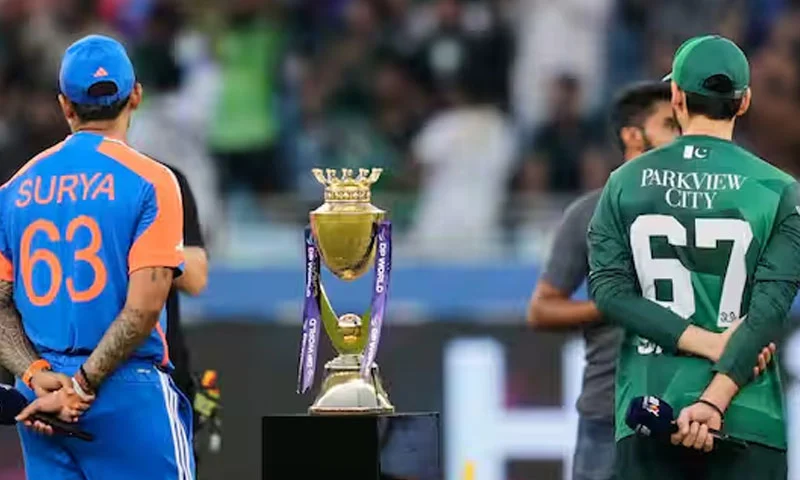
The debate around World Cup venues and participation often overlooks a more fundamental reality: the ICC’s commercial sustainability is driven not by geography, but by viewership. At the centre of that equation lies one fixture that has consistently underwritten the financial success of global cricket — India vs Pakistan.
Former Pakistan captain Rashid Latif has repeatedly argued that the ICC’s revenue logic must reflect actual audience contribution rather than political convenience or hosting arrangements. His stance has gained renewed relevance amid discussions over Pakistan’s participation, revenue share, and the ICC’s long-term financial planning.
The ICC’s Biggest Revenue Engine
Across formats and tournaments, India–Pakistan remains the most-watched match in international cricket. Broadcast data over the past decade shows that no other fixture consistently delivers comparable global reach:
-
2011 World Cup final (India vs Sri Lanka): 558 million unique viewers
-
2011 World Cup semi-final (India vs Pakistan): 495 million
-
2017 Champions Trophy group match (India vs Pakistan): 324 million
-
2015 World Cup group match (India vs Pakistan): 313 million
-
2022 T20 World Cup (India vs Pakistan): record digital viewership surging from 10 million to 16 million in the final over
-
2021 T20 World Cup: India–Pakistan reached 167 million TV viewers
These figures highlight a structural truth: Pakistan’s participation is central to the ICC’s broadcast value, especially in marquee events.
Revenue Distribution: A Structural Imbalance
Under the 2024–27 ICC revenue model, India is allocated 38.5% of total revenues, while Pakistan’s share stands at 5.75%. Rashid Latif and other analysts argue this gap fails to reflect Pakistan’s disproportionate role in generating peak viewership.
From Pakistan’s perspective, the India–Pakistan fixture is a shared commercial asset, not a unilateral one. Without Pakistan, the most valuable broadcast property in global cricket simply does not exist.
Latif has publicly stated that the PCB should have pressed harder during negotiations for the next cycle, proposing that Pakistan’s share be revised to 18–20% for the 2027–30 financial period, aligned more closely with its contribution to audience demand.
What If Pakistan Does Not Play?
A key question confronting the ICC is the potential revenue impact if Pakistan were absent from ICC events. Industry experts agree the effect would be financially severe, particularly in broadcast markets across South Asia, the Middle East, the UK, and digital platforms worldwide.
While sponsors such as Emirates Airline, DP World, and Saudi Aramco play major roles, sponsorship alone does not replace live viewership-driven broadcast income, which remains the ICC’s primary revenue stream.
This raises another critical issue: should revenue sharing be driven by sponsorship geography or by actual audience numbers? Latif’s position is clear — viewership, not venue or sponsor nationality, should determine revenue distribution.
The Strategic Reality
The ICC’s long-term viability depends on recognising that commercial sustainability flows from audience engagement. Any model that underrepresents Pakistan’s contribution risks weakening the very product that global cricket relies on.
As Rashid Latif has consistently argued, the solution lies not in confrontation, but in a realistic, data-driven revenue framework that reflects where cricket’s true value is generated.