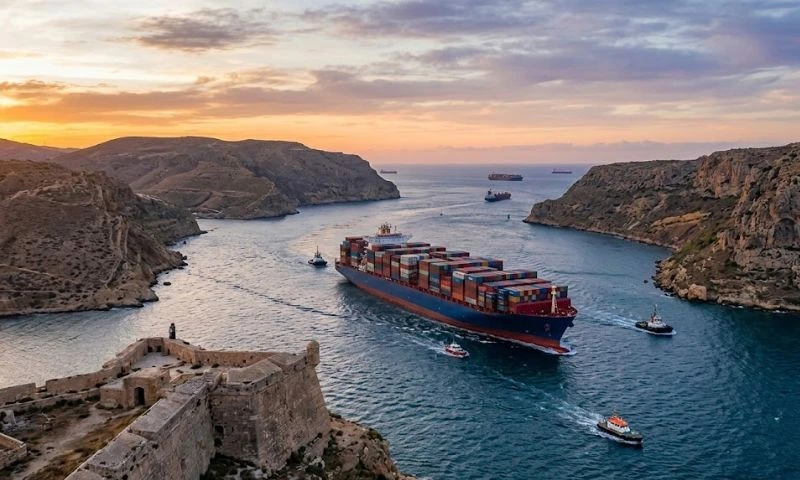
The global economy is not a static machine but a flowing river. Much of this flow happens on the open sea. Approximately 80 percent of global trade by volume moves across the oceans. This massive system depends on six critical shipping lanes. These narrow passages act as the primary arteries of international commerce. If one is blocked, the world feels the impact immediately through rising prices and empty shelves.
The Strait of Hormuz: The Worlds Energy Tap
The Strait of Hormuz is arguably the most vital chokepoint on the planet. Located between Oman and Iran, it connects the Persian Gulf with the Gulf of Oman and the Arabian Sea. According to the U.S. Energy Information Administration, “The Strait of Hormuz is the world’s most important oil transit chokepoint.” About 21 million barrels of oil pass through this narrow stretch daily. This represents 21 percent of global petroleum liquid consumption. Because there are few alternative routes for Gulf oil, any closure here could cause a global energy crisis.
Read More: Strait of Hormuz Closure Sparks Global Shipping Crisis and Higher Costs
The Malacca Strait: Asia’s Economic Gateway
Further east lies the Malacca Strait. This narrow stretch between Indonesia and Malaysia is the primary gateway between the Indian and Pacific Oceans. It handles more than 90,000 vessels annually. It carries 25 percent of the world’s traded goods. This includes massive amounts of Chinese oil imports and manufactured products bound for Europe and the Americas. Its narrowest point is only 1.5 miles wide, creating a natural bottleneck for global shipping.
The Suez Canal: The Essential Shortcut
In the Middle East, the Suez Canal remains a legendary shortcut. Connecting the Mediterranean to the Red Sea, it allows ships to avoid the long journey around Africa. It handles roughly 12 percent of global trade. When the Ever Given ship got stuck in 2021, it halted nearly 10 billion dollars in trade every day. This event proved how much the modern world relies on this single canal.
The Bab el Mandeb: The Gate of Tears
The Bab el Mandeb sits between Yemen and Djibouti. It links the Red Sea to the Gulf of Aden. Security here is often tense due to regional conflicts and piracy. This passage is vital for European energy security because it carries millions of barrels of oil and liquefied natural gas daily. Without it, ships would have to navigate the Cape of Good Hope, adding weeks to their journeys.
The Panama Canal and Turkish Straits
Across the Atlantic, the Panama Canal serves as the bridge between the two great oceans. Unlike the others, this is a human made system of locks. It saves ships an 8,000 mile journey around South America. Recently, climate change and droughts have lowered water levels, forcing the canal authority to limit vessel weight. Finally, the Turkish Straits connect the Black Sea to the Aegean. These include the Bosphorus and the Dardanelles. They are essential for grain and oil exports from Russia and Central Asia.
Read More: Strait of Hormuz Shutdown Sparks Fuel Shortage Fears: Five Ways Countries Can Reduce Fuel Use
International trade is efficient but fragile. The United Nations Conference on Trade and Development notes that “disruptions to these maritime routes can lead to higher prices for consumers everywhere.” We must protect these lifelines to keep the world moving.