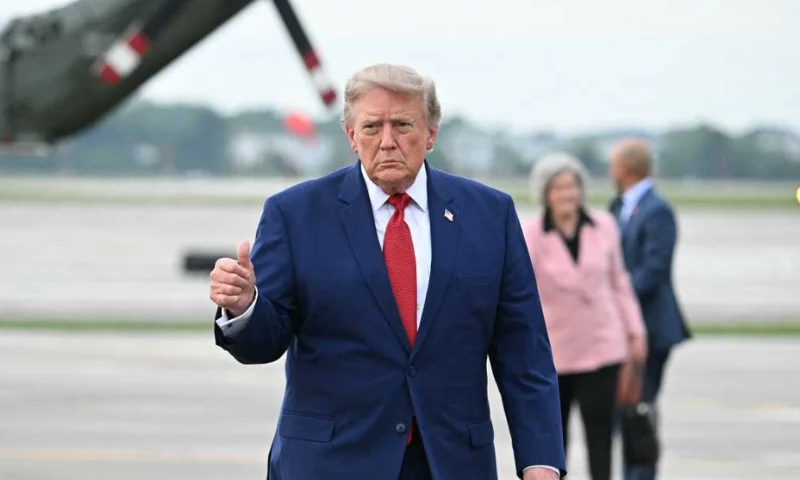
US President Donald Trump said Washington had secured majority control of more than 65 billion barrels of Venezuelan oil through an agreement with Caracas.
The volume represents about one-fifth of Venezuela’s proven reserves. Trump said American companies would revive production and send more crude to US refineries, potentially easing fuel prices.
Venezuela holds about 303 billion barrels, the world’s largest proven reserves. However, years of underinvestment, sanctions and mismanagement have limited production to about 1.25 million barrels per day.
Trump announces unprecedented oil agreement
“At my direction, Secretary of State Marco Rubio, and Secretary of War Pete Hegseth, working closely with Highly Respected Interim President of Venezuela, Delcy Rodriguez, and, through a partnership with private business, have secured majority US control of more than 65 BILLION BARRELS of proven Oil Reserves in Venezuela, at no cost to the American Taxpayer,” Trump wrote on Truth Social.
Trump did not name the companies or explain Washington’s control mechanism. Reuters located the fields in the Orinoco Belt and Lake Maracaibo.
The announcement followed weeks of talks over long-term access and guaranteed US crude supplies. Venezuelan officials plan to award exploration and production rights next week.
AP cited an unnamed US official saying a new company would receive 100-year development rights. Washington would obtain 55 percent of its output and buy crude at cost.
https://t.co/cs57vy5Bvu pic.twitter.com/E63R8Hm3Sj
— Rapid Response 47 (@RapidResponse47) August 29, 2026
Venezuela expects $100 billion investment
Rubio said the deal would secure low-cost US oil, lower gasoline prices, attract nearly $100 billion, create thousands of high-paying jobs and rebuild Venezuela’s economy.
Interim President Delcy Rodriguez said the agreement would develop 17 strategic fields and generate $209 billion in Venezuelan tax revenue.
“These investments will contribute not only to the recovery and modernization of our industry, but also to our country’s economic growth, the energy security of our hemisphere, and greater balance in international markets,” Rodriguez said.
Legal and investment questions remain
Analysts said the unpublished agreement left major legal and financial questions unanswered. Reuters said officials considered leases and auctions to US producers. However, Venezuela’s constitution and hydrocarbons law reserve core oil activities for the state.
David Goldwyn, president of Goldwyn Global Strategies, said there was “no precedent for having the US government enter into a lease to operate oil fields”.
“It is hard to see how this kind of arrangement would accelerate investment at any material scale,” he said. Goldwyn cited political uncertainty, power shortages, restricted export capacity and government control.
Venezuela’s heavy crude also requires expensive infrastructure for production, transport and refining. Therefore, the agreement may not reduce fuel prices quickly.
The deal follows Washington’s capture of President Nicolas Maduro in January. Venezuela nationalised oil in the 1970s around PDVSA. Hugo Chavez later forced state-led ventures and expropriated ExxonMobil and ConocoPhillips projects.
The announcement comes before November’s US midterm elections. Gasoline averaged about $4.09 per gallon on Friday. The Strategic Petroleum Reserve had fallen to 289.7 million barrels, its lowest level since 1982.