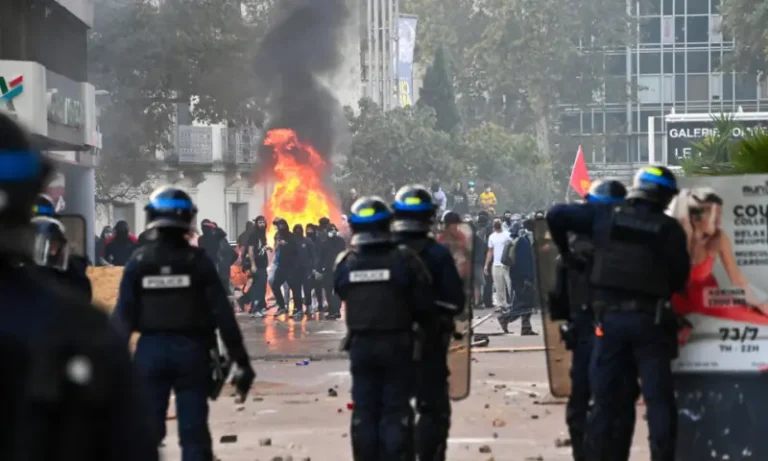


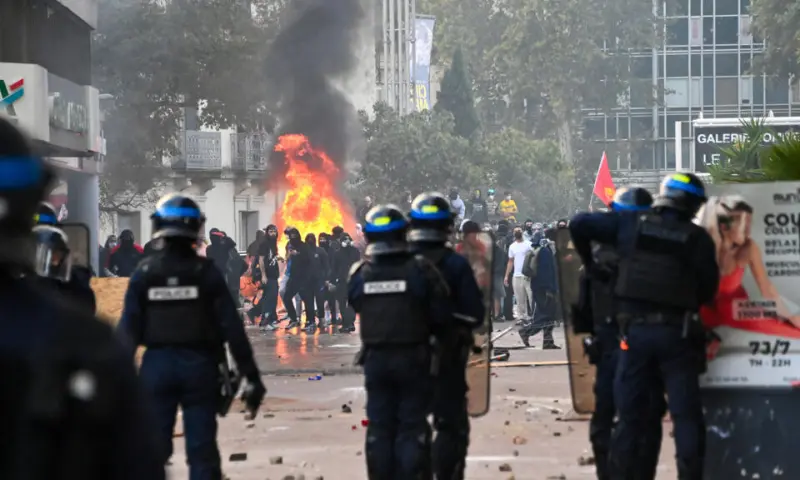
France will deploy about 70,000 security personnel nationwide on Saturday, October 24, following some of its worst urban violence in years.
Interior Minister Laurent Nunez warned that social media carried calls for violence and looting. The deployment represents roughly 20 percent more personnel than last weekend, amid questions about police preparedness and intelligence.
High school protests over learning conditions sparked the movement, which expanded as anger over living costs spread. Reuters reported that elite units, armoured vehicles, helicopters and water cannon would support regular police.
President Emmanuel Macron met secondary school representatives on Friday. They urged students to continue protesting until the government offered concrete proposals.
His government has distinguished legitimate grievances from the looting, fires and ransacking that accompanied last Saturday’s demonstrations.
Justice Minister Gerald Darmanin said courts had jailed 217 people, half of them first-time offenders.
On Thursday, Macron demanded “the utmost severity” against “acts of delinquency”. He accused “ultra-left” groups of seeking to “bring down the republic”.
An extreme-left group in western France urged supporters online to be “uncatchable, unpredictable, to evade the deployment” of police.
Authorities expect 20,000 to 30,000 counter-protesters in Orleans, where Marine Le Pen will host her National Rally congress this weekend. Thousands of party supporters will attend, raising fears of clashes.
The prefecture has barred the counter-demonstration from the city centre. Lyon has also closed central areas to protesters.
Paris police revoked permission for a union march between Bastille and Nation squares. They offered an afternoon route along the city’s southeastern edge instead.
Unions pledged to use the original route, citing safety concerns about the alternative.
Marseille authorities reversed an earlier ban, allowing a union demonstration on an “exceptional basis”. It remains the only authorised protest in Bouches-du-Rhone.
Leading Paris museums, including the Louvre, will close on Saturday. Art Basel has shortened its programme.
Amnesty International condemned “a slide toward authoritarian practice”, saying restrictions were “jeopardising the right to demonstrate peacefully”.
“Police have a responsibility both to ensure that protests can take place peacefully and safely and to protect the public from violent disorder,” said Eva Cosse, senior Europe researcher at Human Rights Watch.
She also expressed alarm over reports that crowd-control weapons had severely injured children during recent gatherings.
The unrest comes six months before elections to replace Macron. Violence has damaged France’s image, while its government debt continues to concern investors.
A Harris Interactive poll for M6/RTL, conducted after the violence, put Le Pen ahead with 33 to 35 percent in first-round voting. It suggested hard-left leader Jean-Luc Melenchon would reach the runoff against her.
The poll projected Le Pen winning that contest with about 70 percent, indicating stronger support following the unrest.