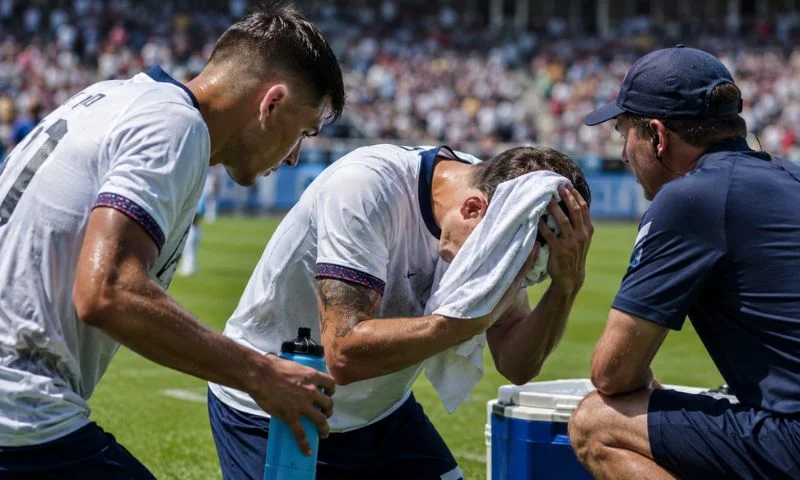
FIFA has introduced mandatory hydration breaks at the 2026 World Cup for the first time in tournament history. The move aims to protect players from extreme heat as experts warn that this year’s competition could become one of the hottest World Cups on record.
The governing body now requires a three-minute hydration break midway through each half of every match. The rule applies regardless of weather conditions or whether a stadium is enclosed or air-conditioned.
FIFA said the measure seeks to “ensure equal conditions for all teams, in all matches.”
The decision follows concerns raised during recent tournaments. Last year’s FIFA Club World Cup in the United States saw temperatures climb into the mid-30s Celsius in several host cities.
However, the policy has divided opinion.
Some coaches argue that mandatory breaks disrupt the rhythm of matches. Others believe the pauses give managers an opportunity to alter tactics and influence momentum.
At the same time, sports scientists say the breaks may not last long enough to effectively cool players during extreme conditions.
“When we look at the three minute hydration breaks, we’re really looking at this as a way to mitigate anything that could potentially lead to an incident or an emergency,” said Joshua L. DeVincenzo, assistant director of applied research services at Columbia University’s National Center for Disaster Preparedness.
Scientists warn elite athletes remain vulnerable
Experts say even the world’s best athletes remain susceptible to exertional heat illness when they compete in hot and humid environments.
The condition occurs when body temperature rises to dangerous levels and places significant stress on the heart, muscles and nervous system.
Common symptoms include cramps, fatigue, dizziness, headaches and dehydration. In severe cases, athletes may suffer exertional heat stroke.
“When internal body temperature exceeds 105 F (40.5 C), athletes might feel confused, aggressive or lose consciousness,” said Yuri Hosokawa, associate professor at Waseda University in Japan.
Hosokawa recently joined other experts in urging FIFA to adopt stricter heat protocols. In May, a group of scientists sent a letter recommending cooling breaks of at least six minutes.
Research shows that athletes can lose one to two litres of fluid per hour during intense exercise in hot conditions. Furthermore, losing just 2% of body weight through dehydration can reduce physical performance.
Ryan Calsbeek, a professor of biological sciences at Dartmouth College, said athletes eventually reach a point where the body struggles to regulate temperature.
“Your body starts to really fall apart, you lose the ability to cool off fast enough,” he said.
Calls grow for longer cooling breaks
Experts agree that hydration breaks help reduce risk. However, many argue that three minutes provides limited time for meaningful cooling and rehydration.
Douglas Casa, chief executive of the University of Connecticut’s Korey Stringer Institute, said cold towels and aggressive cooling strategies can lower body temperature. Nevertheless, he believes longer breaks would produce far better results.
“That’s why we’re suggesting doing something like five or six minutes, because it just makes such a big impact when you’re dealing with a change of that magnitude,” he said.
Meanwhile, climate experts expect heat-related challenges to become more common across global sport.
Bharat Venkat, director of the Heat Lab at the University of California, Los Angeles, said sporting organisations will need to adapt.
“No matter what sport you play, there’s going to be adjustments that have to be made in the face of climate change,” he said.
As temperatures continue to rise worldwide, the debate over player safety is likely to remain a major issue long after the final whistle of World Cup 2026.