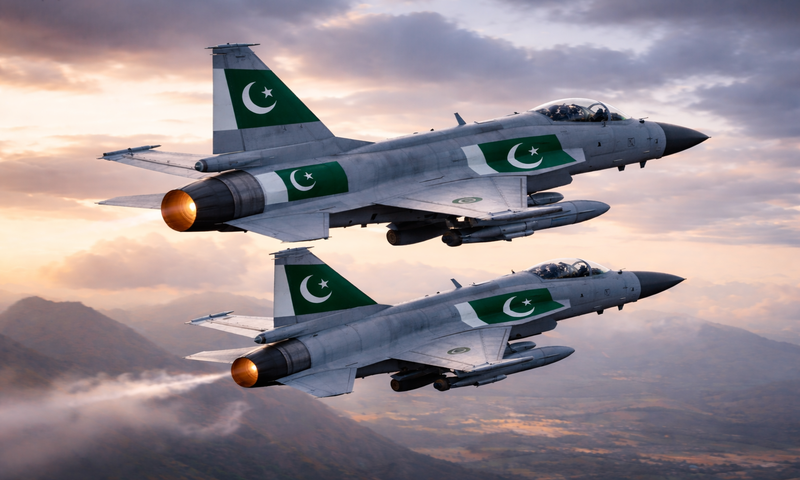
For years, the JF-17 Thunder has been a central pillar of Pakistan’s air defence strategy. But following the military confrontation with India in May last year, the aircraft’s relevance has expanded well beyond national security. Today, the JF-17 is increasingly viewed as a tool of diplomacy, industrial growth, and economic opportunity — reshaping how Pakistan is perceived on the global stage.
Developed and manufactured at Pakistan Aeronautical Complex in collaboration with China, the JF-17 represents one of Pakistan’s most advanced indigenous defence projects. Its growing visibility during recent regional tensions brought renewed international attention to the platform, particularly among countries seeking affordable yet capable combat aircraft.
Major International Interest and Negotiations
1. Bangladesh
Pakistan and Bangladesh have engaged in discussions over a potential defense pact that would include the sale of JF-17 fighters. This development follows improved diplomatic relations and could be one of the first export deals if finalized.
2. Saudi Arabia
Pakistan and Saudi Arabia are reportedly in talks to potentially convert roughly $2 billion in Saudi loans into a JF-17 purchase deal, deepening defense cooperation between the two nations. While not formally concluded, the talks point to a strategic bond being reinforced around this aircraft.
3. Indonesia
Officials from both Pakistan and Indonesia are advancing negotiations that could include the sale of over 40 JF-17 jets alongside Pakistani drones — part of Indonesia’s effort to modernize its air force. These discussions are described as progressing, though no final contract has been signed yet.
4. Iraq
Recent meetings between the air chiefs of Pakistan and Iraq have reportedly included expressions of interest by Iraq in acquiring JF-17 fighters along with support aircraft, signaling a widening defense relationship.
5. Libya and Sudan
Pakistan has already concluded a major arms deal with Libya valued at around $4 billion, and is close to finalizing a $1.5 billion deal with Sudan that could include JF-17 fighters alongside other defense systems.
6. Other Potential Operators
Historical sources show that countries such as Nigeria and Myanmar already operate JF-17 aircraft, and various other nations have been reported in past years as potential future customers.
What makes the JF-17 attractive is not just its operational capability, but the flexibility Pakistan offers in training, maintenance, and long-term support. Defence analysts note that many developing air forces are under pressure to modernize without relying heavily on costly Western platforms or restrictive procurement conditions. In this space, Pakistan has positioned itself as a credible and pragmatic partner.
JF-17 talks confirmed with multiple countries, minister avoids naming them
Speaking in an interview with BBC Urdu, Haraj said Pakistan is currently engaged in discussions with several countries interested in acquiring the multirole combat aircraft. However, he declined to disclose the names of potential buyers, stressing that such negotiations remain confidential until formal agreements are reached.
Beyond Defence: An Economic Opportunity
The growing demand for the JF-17 carries significant economic implications for Pakistan. Defence exports are increasingly being viewed by policymakers as a potential source of foreign exchange at a time when the country is seeking to stabilise its economy and reduce reliance on external borrowing.
Aircraft manufacturing, maintenance, and upgrades generate skilled employment, support local supply chains, and strengthen Pakistan’s industrial base. Each potential export deal also opens doors for ancillary services — including pilot training, technical support, spare parts, and long-term maintenance contracts — creating sustained economic value rather than one-time sales.
Importantly, defence production anchored within Pakistan helps retain technological expertise at home, while enhancing the country’s bargaining power in international partnerships. Analysts argue that successful export programmes like the JF-17 can gradually shift Pakistan from being seen solely as a security-dependent state to one with tangible industrial and manufacturing credentials.
Strategic Significance for Pakistan
The JF-17’s expanding footprint is also reinforcing Pakistan’s strategic relevance. Defence cooperation often translates into deeper diplomatic ties, particularly with countries in Africa, Southeast Asia, and the Middle East that are diversifying their security partnerships.
By offering a combat-proven, cost-effective fighter platform backed by local production, Pakistan is carving out a niche in a competitive global defence market. This not only strengthens bilateral relations but also places Islamabad in conversations traditionally dominated by larger arms exporters.
A Symbol of Capability and Confidence
From a national perspective, the JF-17 Thunder has evolved into more than a fighter jet. It represents Pakistan’s ability to design, manufacture, and export complex military systems — an achievement that carries both symbolic and practical weight.
As interest continues to grow, the aircraft stands at the intersection of defence readiness and economic ambition. For Pakistan, the success of the JF-17 is increasingly tied not just to air superiority, but to broader goals of industrial resilience, strategic influence, and economic recovery.