The official ball of the 2026 FIFA World Cup has already achieved something no player can claim before the tournament begins.
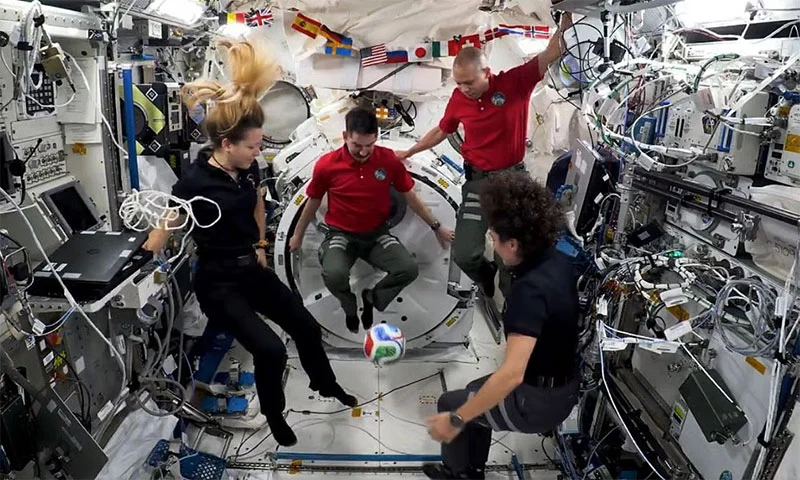
Astronauts aboard the International Space Station tested Adidas’ Trionda football in space to study how balance and movement affect performance.
The experiment formed part of a scientific project designed to better understand how footballs behave under unique conditions.
NASA shared images from the tests on Instagram and explained that astronauts recreated a study first conducted in 2019.
The agency said the exercise showed how small differences in balance can change the way a football moves.
“The official FIFA World Cup ball went to space,” NASA said.
According to the agency, sports engineers carefully adjust a ball’s balance and centre of mass to ensure consistent performance on the pitch.
NASA Studies Football in Microgravity
Astronauts used the Trionda ball to observe its movement in microgravity.
The experiment allowed researchers to examine how balance influences flight and motion without the effects of Earth’s gravity.
NASA said the findings could help scientists better understand how modern football technology influences performance.
“Helping to improve the beautiful game is just one of the ways NASA science done on the International Space Station makes life better for people on Earth,” the agency said.
Researchers often use the ISS to conduct experiments that would be difficult to perform on Earth.
Microgravity allows scientists to isolate variables and study movement with greater precision.
The project also highlighted the growing role of technology and data analysis in modern football.
Trionda Brings New Technology to World Cup
Adidas developed Trionda for the 2026 FIFA World Cup, which the United States, Canada and Mexico will jointly host.
According to FIFA, the name Trionda comes from a Spanish phrase meaning “three waves”.
The name reflects the tournament’s three host nations.
The ball combines red, green and blue colours. Its design also includes symbols linked to each host country.
A maple leaf represents Canada. An eagle represents Mexico. A star represents the United States.
Adidas equipped the ball with several advanced features.
Deep seams help improve flight stability. Textured details help players maintain control during wet conditions.
The ball also includes connected-ball technology.
A built-in 500Hz motion sensor sends real-time movement data to the Video Assistant Referee system.
Officials can use that information to assist with offside decisions and other key incidents during matches.
FIFA and Adidas describe Trionda as one of the most extensively tested World Cup balls ever produced.
Now, before a single match has kicked off, the ball has already completed a journey beyond Earth and into space.